A journey through the poet’s three homes across Santiago, Isla Negra, and Valparaíso in search of the poet
I was lost in thoughts of Isla Negra, and before I knew it, the one-hour bus ride was over, and we were in Valparaiso.
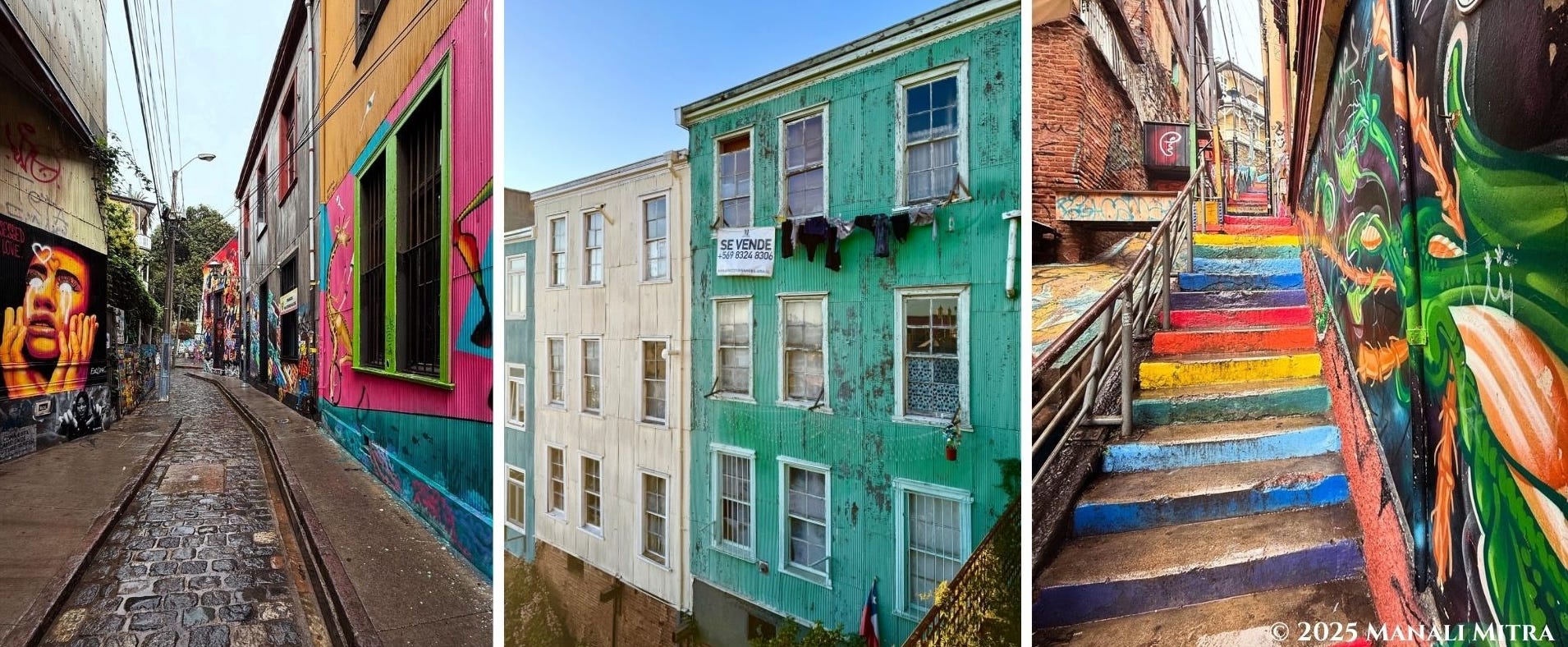
“Valparaiso, how absurd you are, what a lunatic, crazy port, what a head — rolling hills, disheveled, you never finished combing your hair, you’ve never had time to get dressed, life has always surprised you…” —
Ode to Valparaiso, Pablo Neruda
As soon as I got off the bus in the chaos of the terminus, I knew exactly what Neruda meant. The city’s “uncombed” nature showed its teeth immediately when my phone was snatched on the street while I was booking an Uber to reach the hotel. But in a moment of frantic chaos, the city also showed its heart; strangers heard my scream and rushed to nab the thief. I got my phone back! It was an absolute miracle!
Standing there, heart hammering, I realized I had just lived the lines of Neruda’s poem:
“Amo, Valparaíso, cuanto encierras…
(I love, Valparaíso, all that you hold within you)
……Amo tus criminales callejones
(I love your criminal alleyways).”
— El fugitivo en Valparaíso, POEMA VIII, Canto General (1950)
The “criminal alleyways” had just tried to take something from me, but the people who lived in them had given it back.
My grateful spirit kept the excitement alive to visit La Sebastiana the following day.
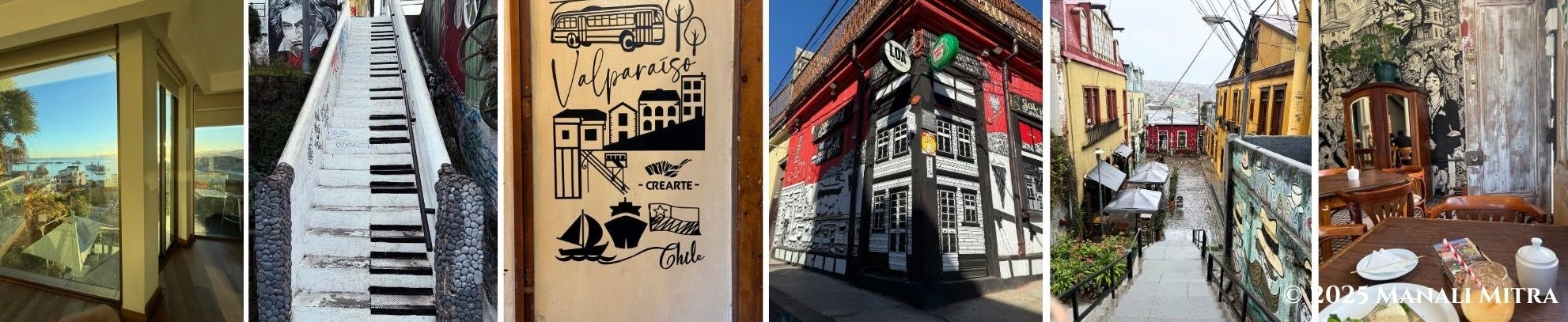
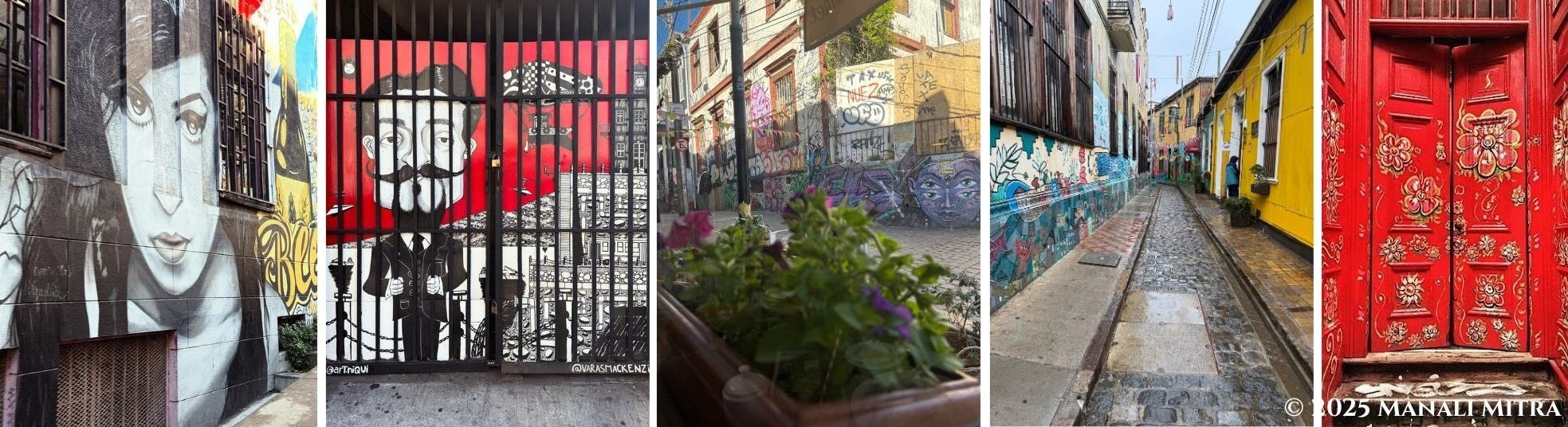
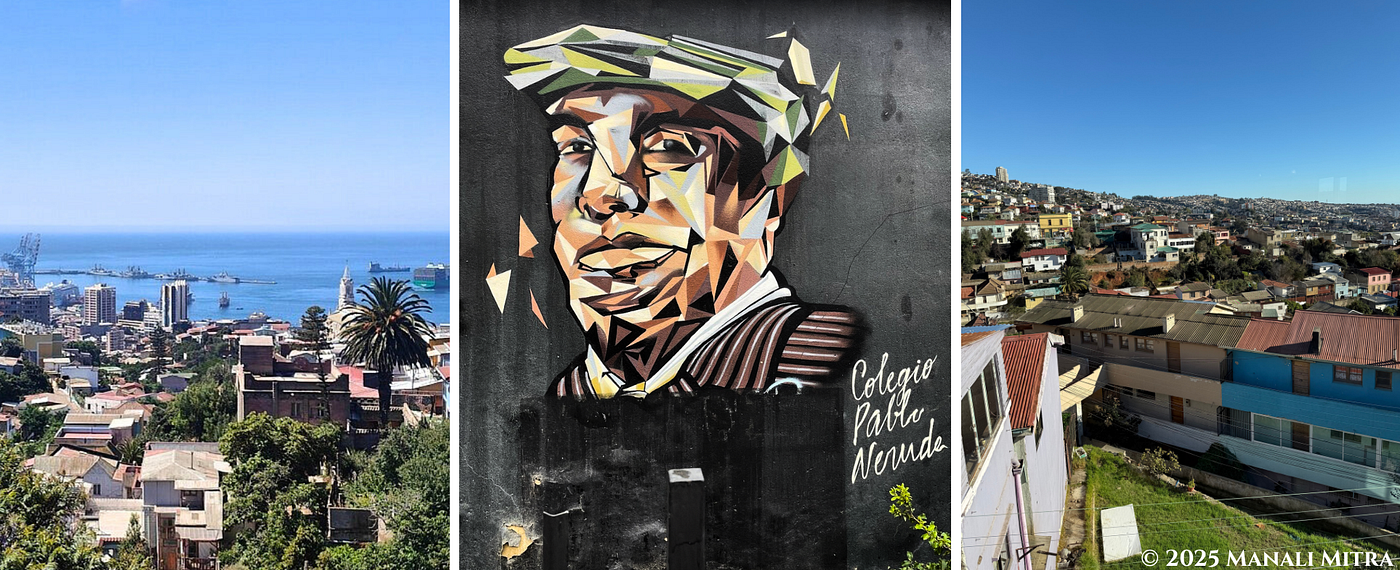
The hotel was at Cerro Concepción, and my room’s breathtaking view over the harbour was the first comfort of the day. Outside, every turn led to an art gallery filled with mind-blowing works by local artists. I spent the rest of the day immersed in the surrounding neighborhood. The incredible sprawl of colorful murals, some born of political soul, others pure creativity, turned crumbling walls into masterpieces. The creative energy was infectious, and it began to clear the dizzying fog of the day’s chaos.
The view from Cerro Concepción(hill) laid the city’s messiness bare. The narrow alleys, the peeling paint, and the murals in eccentric colors; Valparaiso flaunts its messiness with pride. There are so many stairs, all vibrantly painted — one might not have any idea where they lead to! As Neruda described in his memoirs: “The stairs start out from the bottom and from the top, winding as they climb. They taper off like strands of hair, give you a slight respite, and then go straight up. They become dizzy. Plunge down. Drag out. Turn back. They never end.”
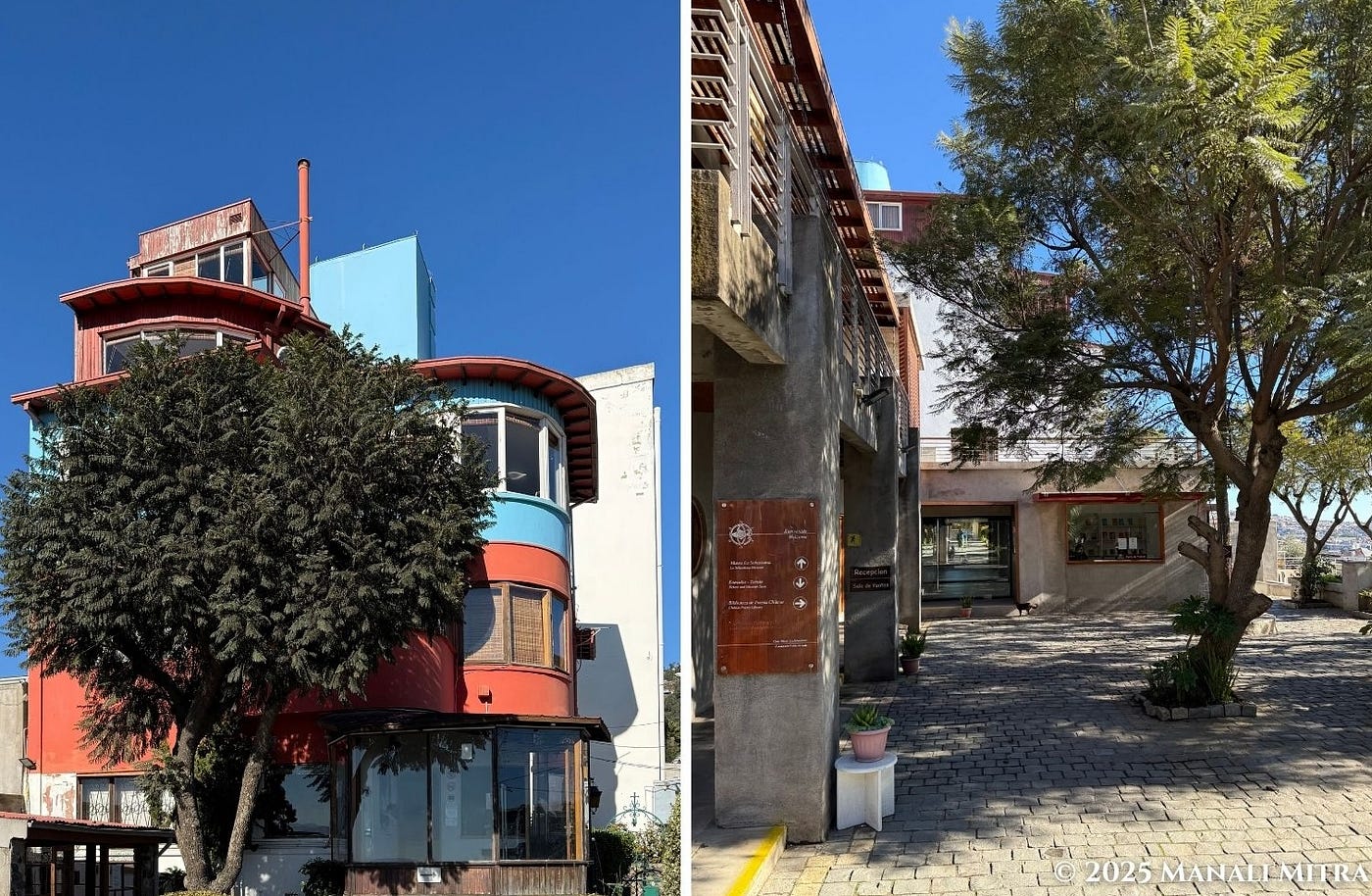
The next morning, I reached the poet’s house early. While it wasn’t open yet, the main gate was already unlatched. I walked in through the courtyard and realised I was the first one to arrive. A few staff members were moving about — one opening the ticket counter, another guarding the entrance to the house. I bought my ticket and, carrying my audio guide, walked toward the house.
The guard at the door mimed with his hands: five more minutes.
I smiled and walked up to him to say hello.
“You… from?” he asked in broken English.
I pulled out my rescued phone, opened the translator app, and typed: “India. I came chasing Neruda.”
He read the screen slowly and looked up, his eyebrows raised in surprise, perhaps wondering at a lone woman from the farthest country standing at the doorstep of a dead poet.
“India?!” he echoed. Tracing a plane’s path in the air with his hand, said “Lejíiiisimos!” gesturing the distance. He continued, curious, “You love Neruda?”
“Yes!!” I beamed.
He glanced back at the empty house, then back at me, his face unreadable for a second. He leaned in and whispered, “Then…you take photo inside… shhh, no in front camera,” pointing toward the CCTV.
I smiled. The city was being very kind to me after the initial hiccup. After two immersive home tours, I was ready to take only mental notes. But with my brain still a bit scrambled from the previous day, a few photos would definitely help me reconstruct my memories when I’d sit down to journal.
I clicked only a few. Out of respect for his kindness, I won’t be sharing them here, but they did help me put the pieces together when I sat down to write.
“I feel Santiago’s fatigue. I want to find a little house in Valparaíso to live and write in peace. It has to have some conditions. It cannot be too high or too low. It should be solitary, but not excessively so. Neighbors, hopefully invisible. They should not be seen or heard. Original, but not uncomfortable. Very winged, but firm. Neither too big nor too small. Far from everything but close to mobilization. Independent, but with shops nearby. Plus it has to be very cheap. Do you think I can find a house like that in Valparaíso?” — This was the assignment that Pablo Neruda had given, in 1959, to his friends Sara Vial and Marie Martner.(Source)
The answer turned out to be La Sebastiana, a five-storey tower built on the unfinished structure started by Sebastián Collado, who died before finishing it. When Neruda visited, he loved the place, secluded yet at the centre of the town. But it was too large for him to buy on his own. So he purchased it together with sculptor/ muralist friend Marie Martner and her husband, Dr. Francisco Velasco. The couple kept the basement, patio, and first two floors, while Neruda took the upper levels and the tower. He later joked that he had lost in the deal, ending up with nothing but stairs and terraces. Then again, those stairs led to one of the best views of Valparaiso’s bay, so he knew exactly what he was doing. The house was named after the original owner.
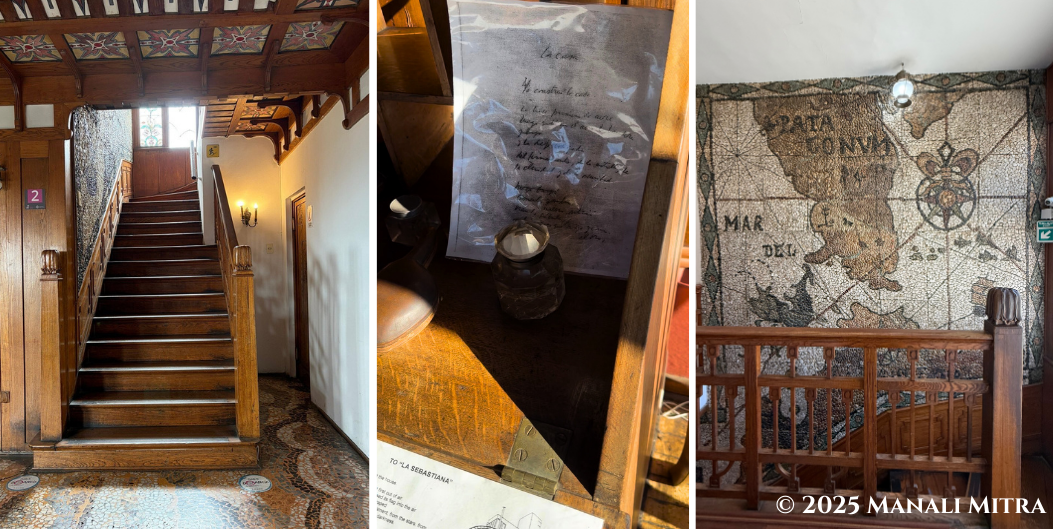
I climbed those stairs now. Next to the staircase, a tall stone mosaic of an old map of Patagonia adorned the wall. It was made by Marie Martner; her work also featured in his other two homes in Santiago and Isla Negra.
Opposite the mural, a very narrow passage led between two golden statues. I walked through it to find a spiral staircase at the back where guests originally entered. Neruda would sit on the bench in that small nook to greet them. Above the bench, on the striped wallpaper, hung the famous painting, The Last Moments of General José Miguel Carrera by Juan Manuel Blanes, depicting the Chilean general in his prison cell before his execution in 1821.
On the third floor, originally a terrace, the poet built the living and dining room. The space opened up into a round, sun-lit, charming area wrapped in bay windows and circular portholes, making it feel like you’re floating above the port. The view was staggering! Valparaíso’s hills were laid out in a maze of colorful houses that looked like they’re sliding into the sea. Neruda liked to celebrate New Year’s Eve in this house and, taking in the view, I could understand why.
The room had this massive quirky white fireplace like a sculptural, pot-bellied urn against the blue walls. To the left, the round dining table with covered with delicate crochet table linen permanently set for six as Neruda never ate alone. The table held his signature colored goblets and, green in his house. In the middle, I loved the white porcelain cow he used for serving punch.
An embalmed flamingo from Venezuela hung from the ceiling; in one corner sat a carousel horse from Paris, collected during his life as a diplomat. His favorite armchair, “La Nube” (The Cloud), and a footstool smudged with his signature green ink faced the window.
Behind the living room was the bar. The colors got even louder with pink and ochre. This was his private territory; no one else was allowed behind the heavy wooden counter. He’d stand there like a captain at the helm, surrounded by his brass ship’s wheel and nautical instruments. Above him hung a large carved wooden fish and a sign that reads “Don Pablo Est Ici” (Don Pablo Is Here). He’d spend his evenings here mixing his signature cocktail, the Coquetelón — a lethal blend of cognac, champagne, and drops of cointreau and orange, served in rare glassware collected from his travels. There was an antique music box and other quirky collectables kept in this area. His most eccentric “challenge” here was a bathroom with an ornate door that allowed far more of a view inside than a guest might expect. It was a classic Neruda prank to see which of his friends was bold enough to sacrifice their privacy for the sake of the party!
By this time, I could hear soft footsteps below and sensed visitors had begun trickling in. I climbed the narrow stairs to the fourth floor and stepped into the bedroom. A warm room in honey-coloured wood and cerulean blue, with a maroon carpet adding a touch of drama. The brass bed facing the bay window had a headboard crowned with a radiant sunburst and its posts topped with brass pineapples — symbol of hospitality. Light streamed in from the large bay window facing the sea, while round stained-glass portholes scattered subtle colours across the room. I could almost picture Neruda lying on the bed, listening to the news on the radio.
Against a blue wall, the striking closet doors were covered in Chinese silk panels painted with elegant figures drifting through landscapes. One door was ajar, revealing Matilde’s shoes neatly lined up inside.
The bathroom on this floor was wrapped in diamond-pattern tiles of sea-green and blue, with windows that let sunlight pour in. The space was divided into two separate rooms, as the poet often joked, Matilde took too long to get ready. I smiled to myself, thinking even Neruda needed his mirror time.
Finally, I was on the fifth floor, the tower — Neruda’s study. His desk faced the massive bay windows, again with a mesmerizing view of the harbor and the city that “twitches like a wounded whale” from earthquakes.
His Royal Bar-Lock typewriter was next to the desk. I stared at its tiered keys and felt grateful that I was actually standing next to his first typewriter that produced so many marvels that led me to travel here. A magnificent brass nautical clock framed by a miniature ship’s wheel was kept next to that, adding warmth to the room’s maritime machinery.
I was blown away by the ornate, blue-and-white ceramic sink, a non-functional masterpiece of cobalt florals. I loved how it was perched in his study serving no purpose other than to feed the poet’s imagination.
On the wall, apart from a map of Chile, there was a life-sized portrait of Walt Whitman, who watched over the room. If anyone asked the poet if he was his father, he’d reply, “Yes, of Poetry.”
I walked up to his desk and spotted the handwritten lines of “La Casa” ( a printed english translation kept next to it by the foundation,) — the very poem he composed for the inaugural party at La Sebastiana in December 1961, reciting it amid guests, cocktails, and bay views:
I built the house.
First, I made it out of the air.
Then I raised a flag in the air
and left it hanging there,
from the sky, from the stars,
from light and from darkness…..
I stood looking out at the bay and hearing Dr. Francisco Velasco’s story on the audio — when he arrived at the house after the Neruda’s death, he discovered a live eagle inside the sealed living room. Though Dr. Velasco set it free, he could never explain how it entered the locked home. He then remembered the poet’s confession: that if he had another life, he wished to return as an eagle.
I turned and made my way down the narrow stairs, leaving the captain to his wings.
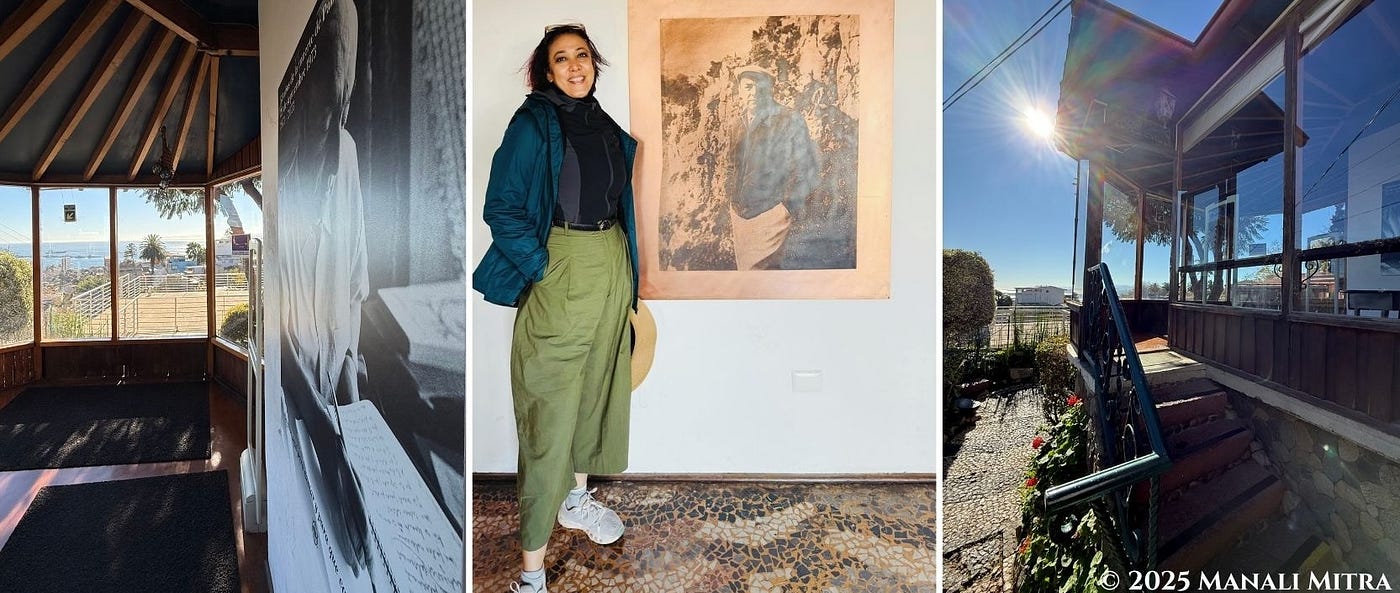
At the exit, I thanked the kind guard, who graciously offered to click my photo with Neruda’s poster. While waiting for my Uber, I turned to take one last look at the “ship on land.”
Thirty-four years is a long time to carry someone’s words in your heart. Ever since Calcutta, I had been moving toward this moment. Now, the loop was finally closed.
I found Pablo Neruda.
© 2026 Manali Mitra. All Rights Reserved.

 The Unsent Postcard | Travel Stories by Manali Mitra
Leave a comment