A journey through the poet’s three homes across Santiago, Isla Negra, and Valparaíso in search of the poet
“Bury me in Isla Negra,
in front of the sea, I know, of every rugged area
of stones and of waves that my lost eyes
will not return to see.”
Neruda’s last wish made sense the moment I stepped into Isla Negra.
I looked out at the breathtaking, jagged black rocks pounded by the Pacific. I was already in love with Isla Negra. Despite the name, Isla Negra (meaning Black Island) is not an island. In the early 1930s, while serving as Chile’s honorary consul in Java, Neruda was fascinated by the dark silhouette of Sumatra across the sea, which inspired the name of this Chilean refuge. And, the black rocks along the shore made the name Isla Negra feel earned.
I had booked a small cabin overlooking the sea. My host, Pedro, an elderly sculptor who lived in the next block, came to pick me up at the bus terminus, such a kind gesture! He even welcomed me with a bottle of Chilean wine, a warm introduction to the local spirit! My cabin was a dream with the bedroom upstairs attached to a tiny balcony with a breathtaking view of the crashing waves. There’s something so wholesome about a weekend where the waves dictate your schedule — falling asleep and waking up to their roar. It was exactly the reset I was looking for!
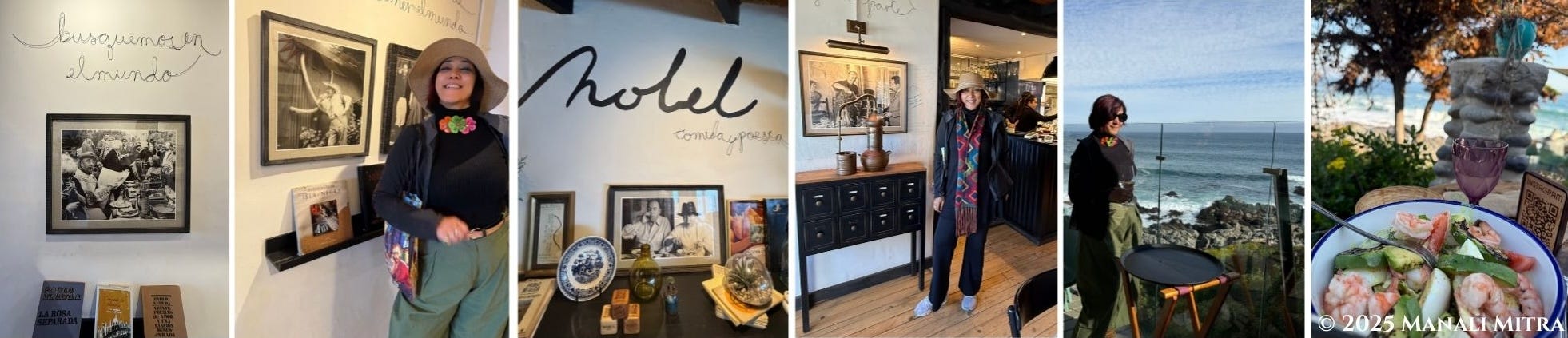
That afternoon, I decided to explore Isla Negra at a slower pace. I walked over to Neruda’s house, but instead of heading straight for the house tour, I stopped at El Noble Neruda — the café located inside the property that one can visit without a museum ticket. I sat there with some wine and shrimp salad, looking out at the sea to soak in the spirit of the place.
After the incredible sensory overload of documenting every secret at La Chascona, I was still basking in the magic of his Santiago home. I had already anticipated that his Isla Negra home (Neruda’s favorite) would be another masterpiece, so I wanted to walk in with fresh eyes. I had the entire weekend to soak it all in.

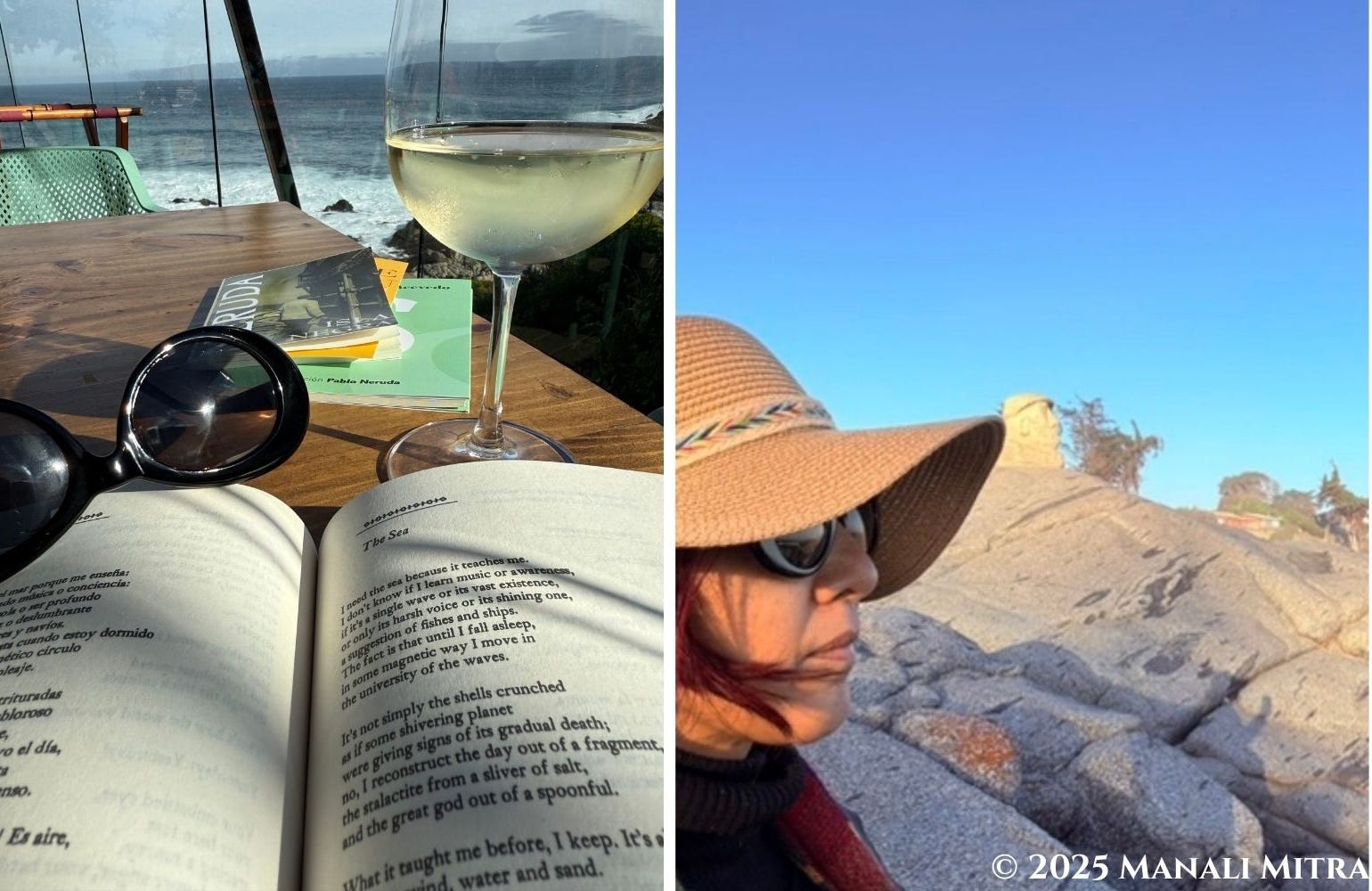
On the walk back, I lingered at the small craft market where local artisans set up their stalls right in front of Neruda’s house. It was a beautiful way to see and interact with the community he loved. Leisurely, I made my way down to the beach and sat near the bust of Neruda, watching the waves relentlessly break against the dark rocks. Yes, I really “need the sea, because it teaches me….. the fact is that until I fall asleep, in some magnetic way I move in the university of the waves.”
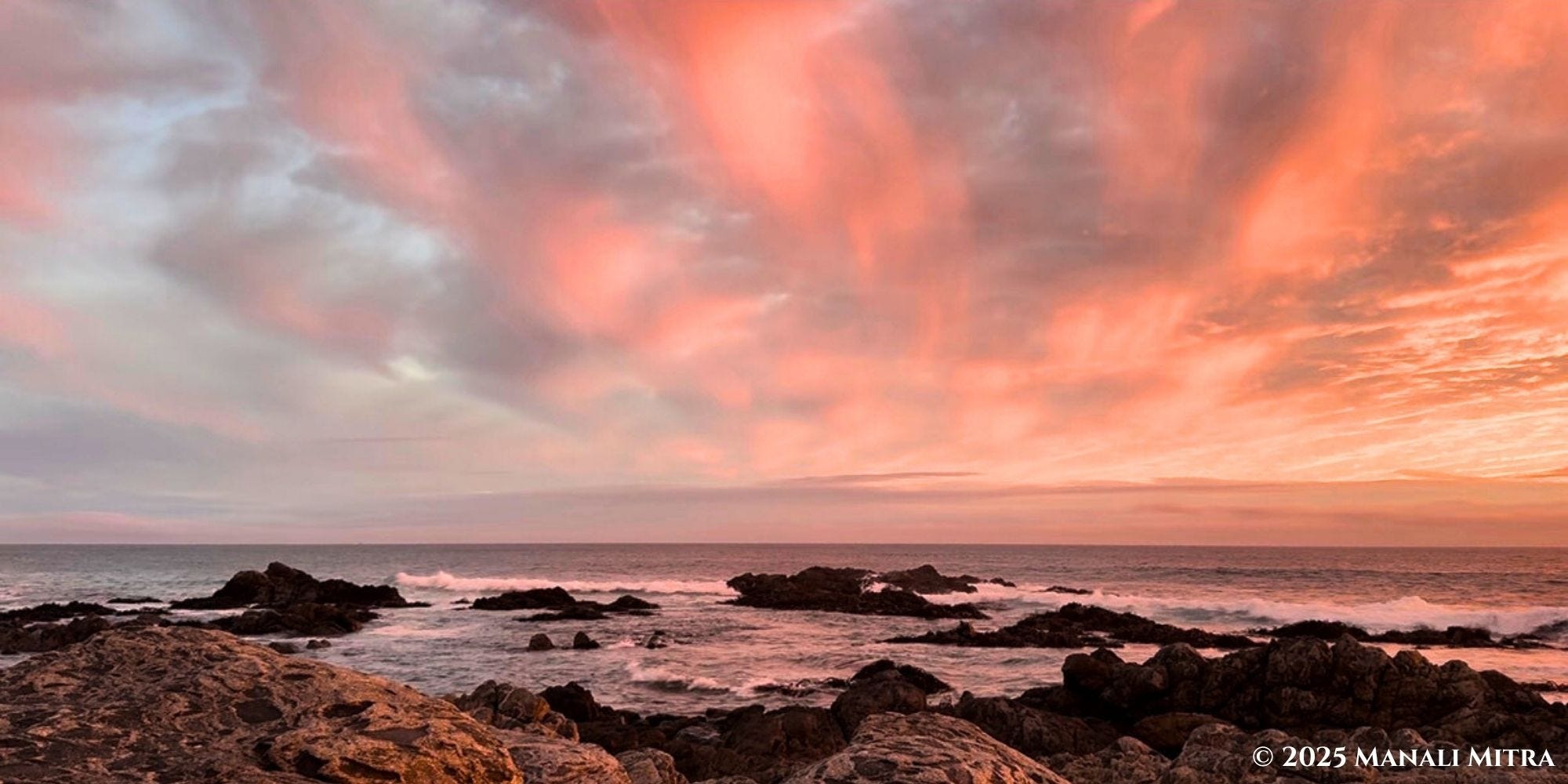
I lost all track of time until I noticed the light beginning to change and the sun slowly setting. The sky ignited, turning a deep, bruised orange over the Pacific. I watched the sun sink into the sea in wonder.
Back at the cabin, I opened the bottle of Chilean wine and settled in the balcony. Even though it started getting cold, I couldn’t go inside. The darkness felt magical, and the sound of the waves was calming.
“Ancient night and the unruly salt beat at the walls of my house. The shadow is all one, the sky throbs now along with the ocean, and sky and shadow erupt in the crash of their vast conflict” — The Night In Isla Negra, Pablo Neruda
I just sat there in the salt-heavy breeze, listening to that “vast conflict” play out in the dark. It was the best way to let the excitement build, savoring the anticipation before finally stepping into the legendary, soulful world of Neruda’s Isla Negra home the next morning.
The next morning, I arrived at his Isla Negra home. As I stepped into the patio, I remembered reading in his memoirs about the struggle it took to make this place his own:
“I needed a place to work. I found a stone house facing the ocean, in a place nobody knew about, Isla Negra. Its owner, a Spanish socialist of long standing, a sea captain, Don Eladio Sobrino, was building it for his family but agreed to sell it to me. How could I buy it? I submitted a projected Canto General, but it was turned down by Editorial Ercilla, my publisher at the time. In 1939, with the help of another publisher, who reimbursed the owner of the house directly, I was finally able to get my house on Isla Negra to work in.” He continued about beginning Canto General, “I felt a pressing need to write a central poem that would bring together the historical events, the geographical situations, the life and struggles of our peoples. Isla Negra’s wild coastal strip, with its turbulent ocean, was the place to give myself passionately to the writing of my new song.”
Over the years, the house expanded in parts, built less by architectural plans and more to fit Neruda’s collections. So, the house grew organically, rooms added whenever new obsessions demanded space. The poet further wrote in his memoirs: “I bought this house in Isla Negra, in a deserted spot, when there was no drinking water or electricity here. With the proceeds from my books, I repaired and refurbished it; I bought wooden statues now dear to me, old ships’ figureheads that found shelter and rest in my home after long journeys.”
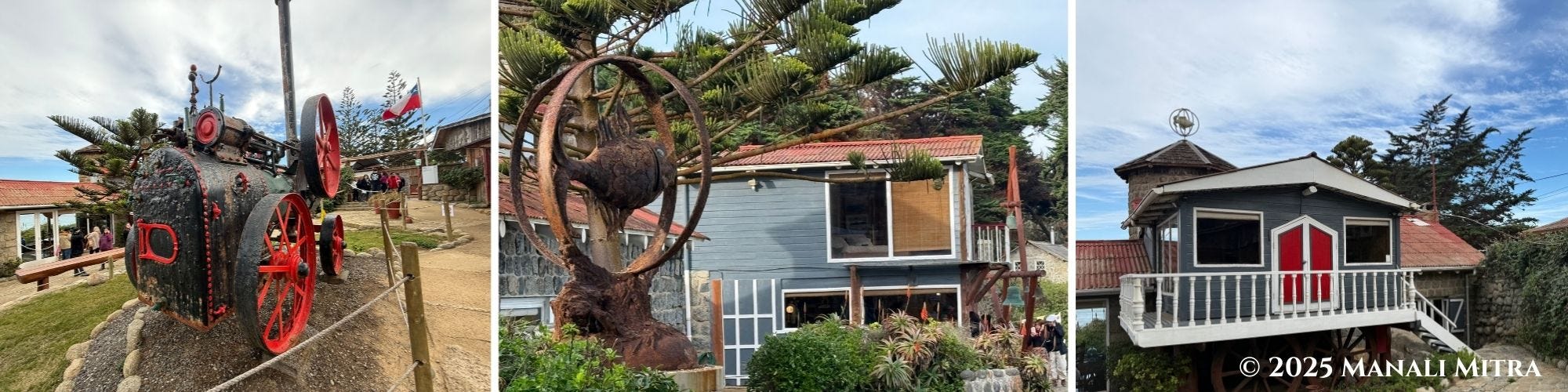
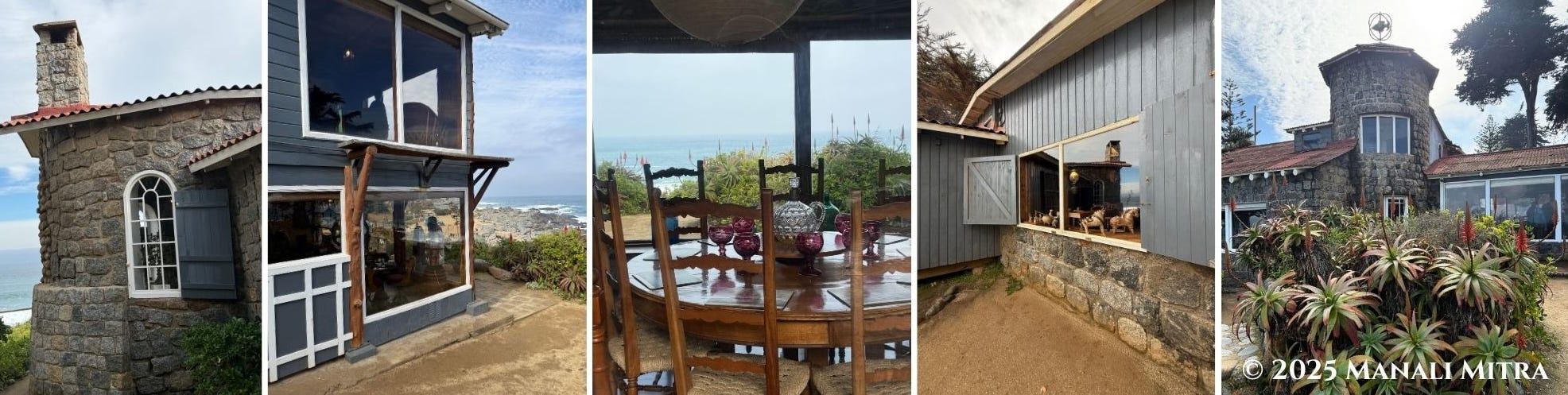
From the outside, the house appeared less like one unit and more like several structures joined together: square, curved, narrow, and round, and bay windows all faced toward the sea. There was an anchor as if mooring the house firmly to the earth below.
At the entrance stood a huge train engine. The son of a train conductor, Neruda remained fascinated by locomotives. He had this one hauled to the cliff at his Isla Negra home using oxen and two Jeeps simply because he loved the machinery of his childhood.
While walking inside, I saw the inscription on the wooden beam: “Regresé de mis viajes. Navegué construyendo la alegría” — roughly translates to “I returned from my travels. I sailed, building joy.” It’s the warm welcome to the house he built so passionately.
“Figureheads are my largest toys. Like so many of my things, these figureheads have been photographed for newspapers and magazines, and have been discussed in a friendly light or with spite. Those who are well disposed toward them laugh understandingly and say, “ What a crazy guy! Look at the kind of thing he’s decided to collect!”
The living room was filled with old ship figureheads, and one that allegedly weeps in winter. In his memoir, Neruda narrated about his favorite one, María Celeste— “I own both male and female figureheads. The smallest and most delightful, which Salvador Allende has often tried to take from me, is the Maria Celeste. She belonged to one of the smaller French vessels and may possibly have sailed only in the Seine’s waters. She is darkish, carved in oak; many years and voyages have given her a dusky complexion for all time. She is a small woman who looks like she’s flying, with signs of a wind carved into her lovely Second Empire clothes. Her porcelain eyes look out over the dimples in her cheeks, into the horizon. And strange as it seems, these eyes shed tears every winter. No one can explain it. The brown wood may have pores that collect the humidity. But the fact is that those French eyes weep in wintertime and I see Maria Celeste’s precious tears roll down her small face every year.”
There were two figureheads in the dining room facing each other: a weathered, pirate-like man commanding one end of the table, and at the other, a poised female figure turned toward the bay window and the distant sea. Neruda deliberately set them facing each other, amused by the idea of staging a romance between woods. Yet he would quip that the affair never happened, as the lady seemed forever drawn to the horizon, ignoring the pirate admirer meant to capture her attention.
The round dining table again had colored goblets, “I like on the table, when we’re speaking, the light of a bottle of intelligent wine. Drink it, and remember in every drop of gold, in every topaz glass, in every purple ladle..” just like he narrated in his “Ode to Wine.”
A narrow wooden staircase led to Neruda and Matilde’s bedroom on the upper level, where massive panoramic bay windows on two sides faced the sea. The bed was placed diagonally so they could watch the Pacific’s endless waves crashing against the rocks below. The delicate crocheted bed linen added a touch of romance to the cozy space. In this room, unlike at La Chascona, I didn’t feel I was intruding, perhaps because my attention kept drifting to the breathtaking view of the waves crashing endlessly below. An adjacent, tiny room held Neruda’s coats and caps, neatly hung together.
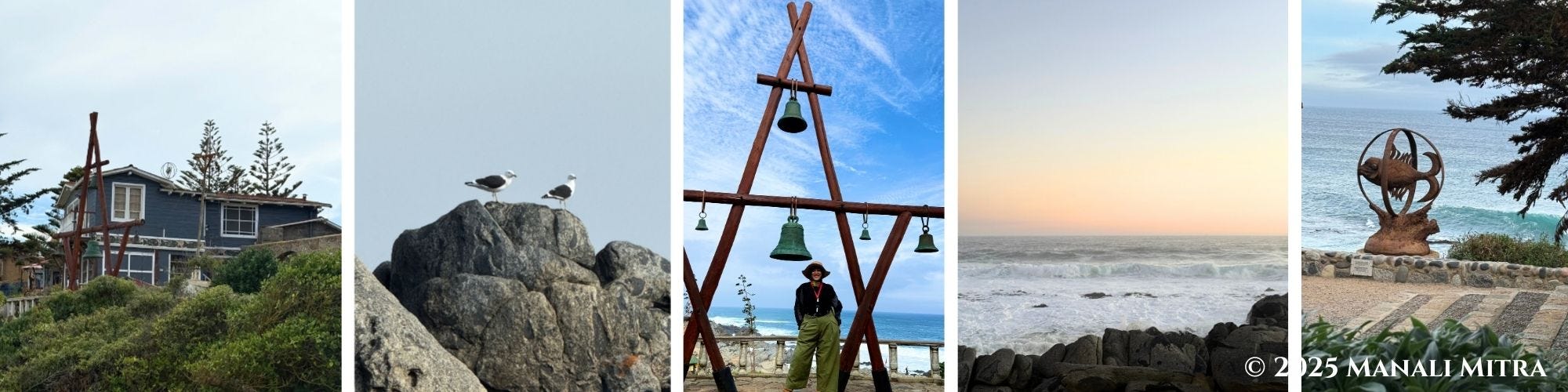
I descended to the garden terrace, where a huge bell tower tied to the logs,
stood overlooking the Pacific. Neruda would ring the bell whenever he returned home, letting neighbors know the “sailor on land” was back. Next to the bell tower was a small white boat, where the poet would sit with friends for drinks, enjoying imagined voyages without ever leaving land.
The terrace led to a narrow hallway that felt like a ship’s passage — a gallery lined with African masks, a country he never visited. Neruda gathered these faces and ships in bottles to decorate the corridor. He wrote in his memoir, “I have a sailboat inside a bottle. In fact, I have more than one. It’s a whole fleet.” They were on display here, creating an atmospheric journey that connected his everyday life to the miniature worlds he loved collecting.
Moving forward, the wood gave way to stone: a stunning fireplace mosaic by Marie Martner. The same artist who created the wall mural at La Chascona. This time, she used lapis lazuli, bright quartz, and dark volcanic rock to build this rugged masterpiece. It was suddenly connecting Neruda’s “sailing” world to the raw minerals and ancient earth of Chile.
The room also had a giant globe, celestial maps, telescopes, and an array of eccentric glassware, alongside portraits of Walt Whitman, Rubén Darío, Garcia Lorca, and Jean Arthur Rimbaud.
One wall had a glass cabinet displaying a vast collection of beetles, moths, and butterflies. Neruda, a self-taught entomologist, viewed the natural world with both a scientist’s eye and a poet’s heart. I was blown away by this extraordinary insect collection, from iridescent metallic blue butterflies to rare moths. In his Ode to a Mariposa, he captured them beautifully:
“For the one from Muzo, that
butterfly of Colombia,
the blue bonfire, which air
combined with the vital metal,
and the other one
from the distant islands,
Morpho, Monarch, Moon-Butterfly,
silvered like fish,
paired like scissors,
embracing wings…”
Neruda kept a life-size Moai Kava Kava statue here, with its left iris deliberately removed to neutralize its well-known supernatural power and turn it into a harmless collectible. He believed the figure’s spirit could bring misfortune, and removing the eye would transform it into a static object among his seashell, insect, and ship figurehead displays — a reflection of his mix of respect for indigenous lore and defiance.
By this point, my senses were brimming. I thought of heading back to the cafe to document what I had already seen and return the next day for the rest. But I was far too fascinated and curious about what lay ahead. The momentum was intense, so I kept going.
“I will not forget the light of the horses,” Neruda wrote. His love for life-sized horses began in his childhood in Temuco, where he passed a local shop daily, captivated by the grand statue and its soft, flowing tail. Decades after the shop burned down, he tracked down the scorched, tailless survivor and finally claimed it as his own. To celebrate this triumphant homecoming, he built a dedicated, stable-like annex in this home. He threw a lavish “welcome party,” asking the guests to arrive in formal attire and to bring equestrian gifts. When three friends arrived with replacement tails, rather than choosing one, Neruda kept them all, blonde, grey, and black, attaching them to different parts of its body. Today, this triple-tailed wonder remains in its special room, a playful monument to Neruda’s passion for reclaiming the magic of his childhood dreams.
In this room, there was the “men-only” bathroom that the poet guarded with terrifying devil masks to keep the ladies out! A prankish hideaway plastered with vintage pin-up girls and an urinal.
Neruda’s favorite room was the last one that had the “gift from the sea.” One morning, the ocean washed a heavy ship’s door into the sand. Neruda and Matilde rushed into the water to save it. They dragged the big, salt-crusted piece of wood home, and Neruda turned it into his writing desk. He kept the old iron hinges on it because he wanted it to feel like a real piece of a shipwreck. He called that ship-door desk his “gift from the sea.” On this desk lay his green ink and a bronze cast of Matilde Urrutia’s hand — a tactile anchor to the woman who inspired so many of his verses, which also served as a paperweight. Right behind this “sea desk” stood another, much simpler one: his father’s desk. His father had been a hardworking railway man, and keeping that modest wooden desk close felt like Neruda’s way of remembering where he came from.
“In reality, the loveliest things I ever collected were my sea-shells. They gave me the pleasure of their extraordinary structure: a mysterious porcelain with the purity of moonlight, combined with numerous tactile, Gothic, functional forms.”- Memoirs, Pablo Neruda
The shell room felt like a glowing gallery, with thousands of Neruda’s “ocean jewels” displayed in glass cases. The Pablo Neruda Foundation built this room after the poet’s death to house his cherished shells. Named Bajo el Mar(Under the Sea ), the room does complete justice to its name, feeling almost like walking through an underwater forest. Even after donating thousands, including rarities like the Glory of the Sea, to the University of Chile, the room still overflowed with wonders — shimmering conches, volutes, delicate nautilus spirals, a variety of cowries, scallop shells, an enormous clam shell, and even a towering narwhal tusk stretching over two meters. A quote ran across the room: “En realidad lo mejor que coleccioné en mi vida fueron mis caracoles.” (the loveliest things I collected in my life were my seashells)
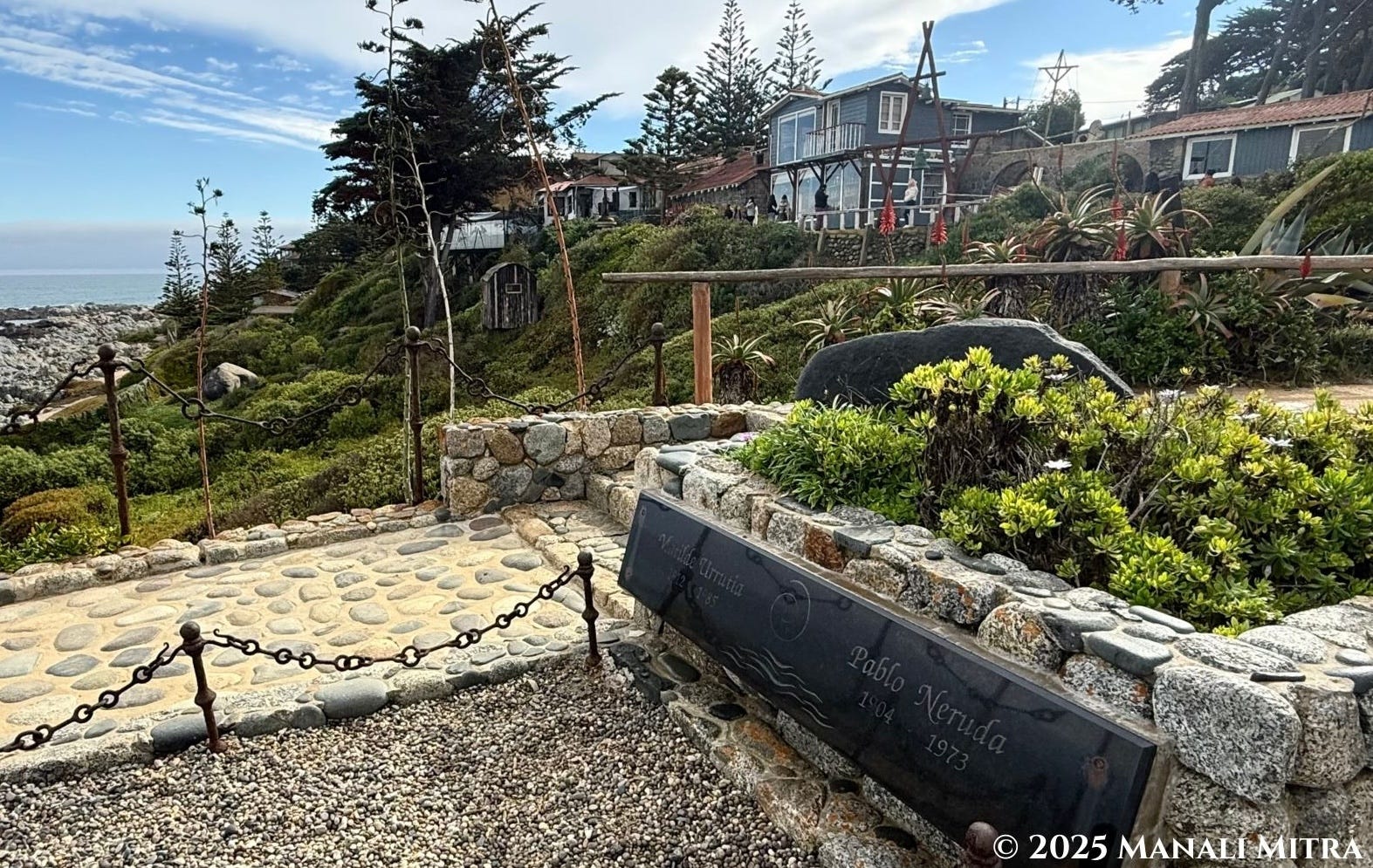
The last stop was in front of the house, where Pablo Neruda and Matilde now rest together. Their grave faces the sea, eternally facing the horizon. A committed socialist and close friend of President Salvador Allende, Neruda died only days after the violent 1973 coup that overthrew Allende’s government. Because of the chaos, he was first buried in Santiago. It took years and Chile’s return to democracy for his remains to be brought back here to Isla Negra, finally fulfilling his wish to remain forever facing the sea.
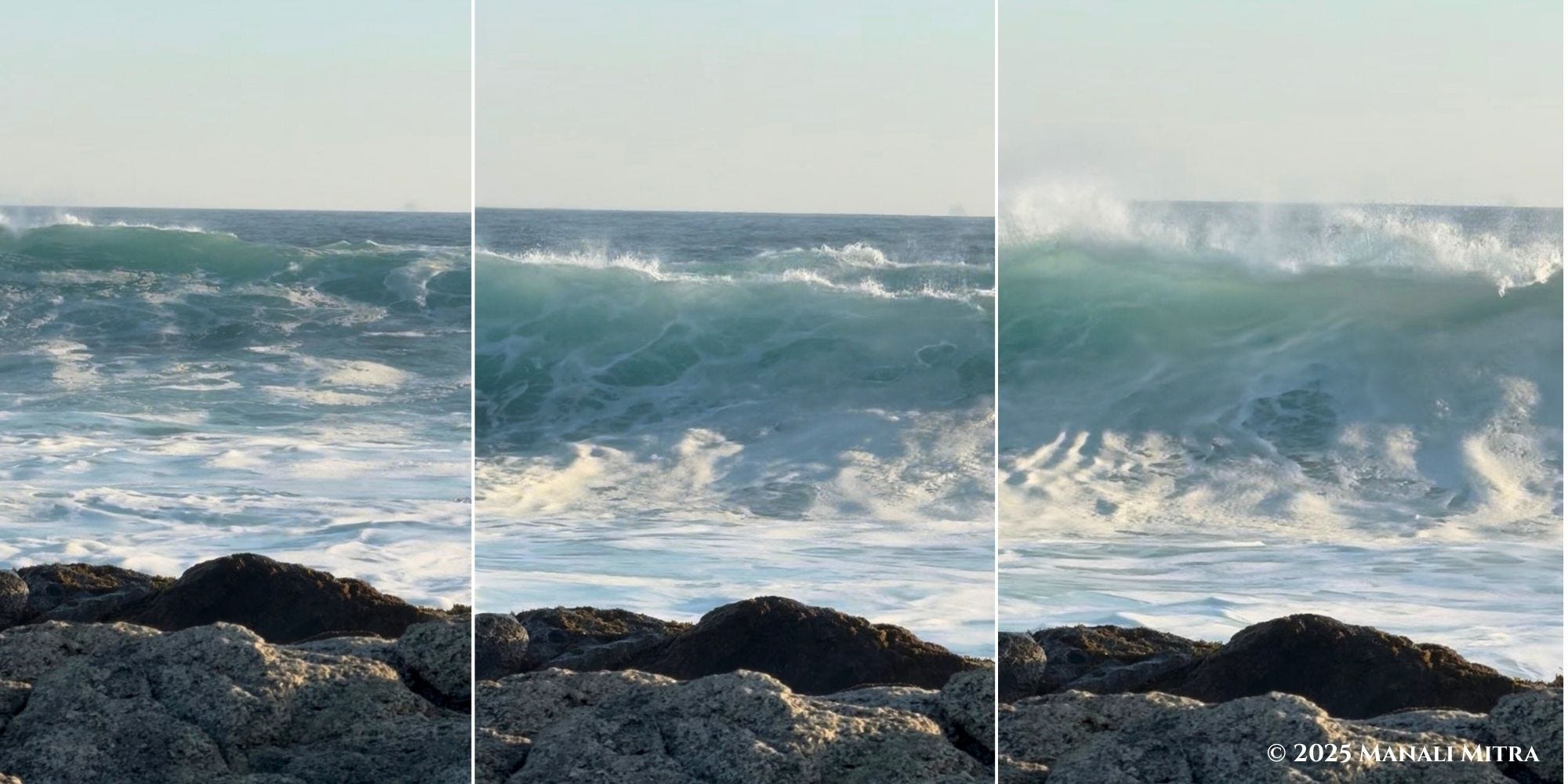
“Yes, but here I am alone.
A wave builds up,
perhaps it says its name,I don’t understand,
it mutters, humps in its load
of movement and foam
and withdraws.Who can I ask what it said to me?
Who among the waves can I name?
And I wait.
Once again the clearness approached,
the soft numbers rose in foam
and I didn’t know what to call them.
So they whispered away,
seeped into the mouth of the sand”
I sat there for a while, the briny scent rising as the waves crashed. Looking out at the Pacific, the journey from Calcutta felt both immense and intimate. Traveling beyond 11,000 miles across the globe to the farthest country from India, I was grateful for the rare privilege to be present at the intersection of my favorite poet’s life, his work, and his final resting place.
But I wasn’t ready to say goodbye just yet. I still had another day, and I returned the next morning, and walked through those rooms once more to let the magic of the “sailor on land” fully sink in before heading to Valparaiso, where his third house, La Sebastiana, waits above the harbor.
The chase continues in Part III: La Sebastiana
© 2026 Manali Mitra. All Rights Reserved.


Leave a Reply