A journey through the poet’s three homes across Santiago, Isla Negra, and Valparaíso in search of the poet
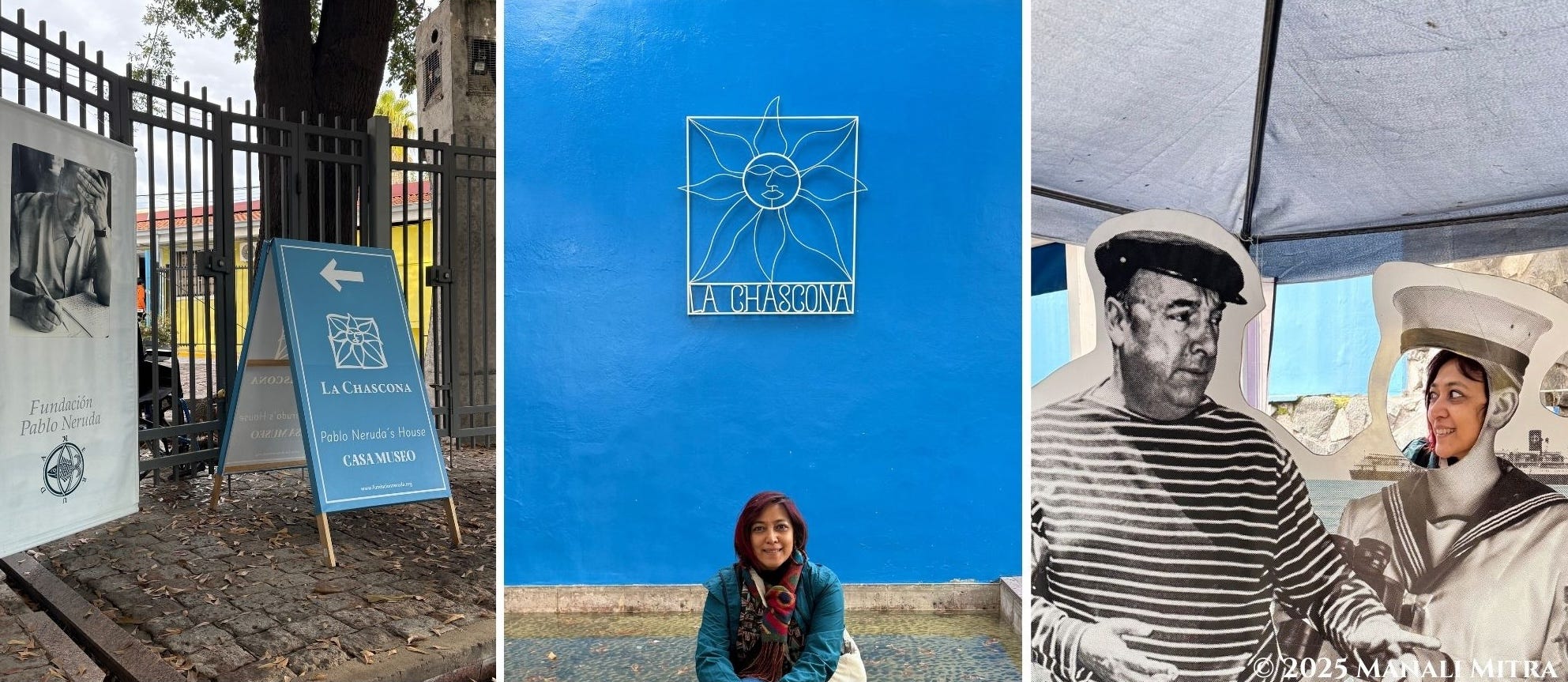
It started in Calcutta around the early 1990s. I would read Pablo Neruda’s work from his poems to his memoirs and then refer to the Oxford Atlas to trace his world. Sitting in Calcutta, his descriptions of distant latitudes felt surreal. I promised myself then that one day I would visit his homes in Chile to see if the stone and mortar could reveal the man behind the poems.
Cut to 2025 — I was in Bellavista, a neighborhood in Santiago. Murals on the walls; art spilled on the pavements, bright houses, cafés bustling with music and chatter. What a fascinating neighborhood!
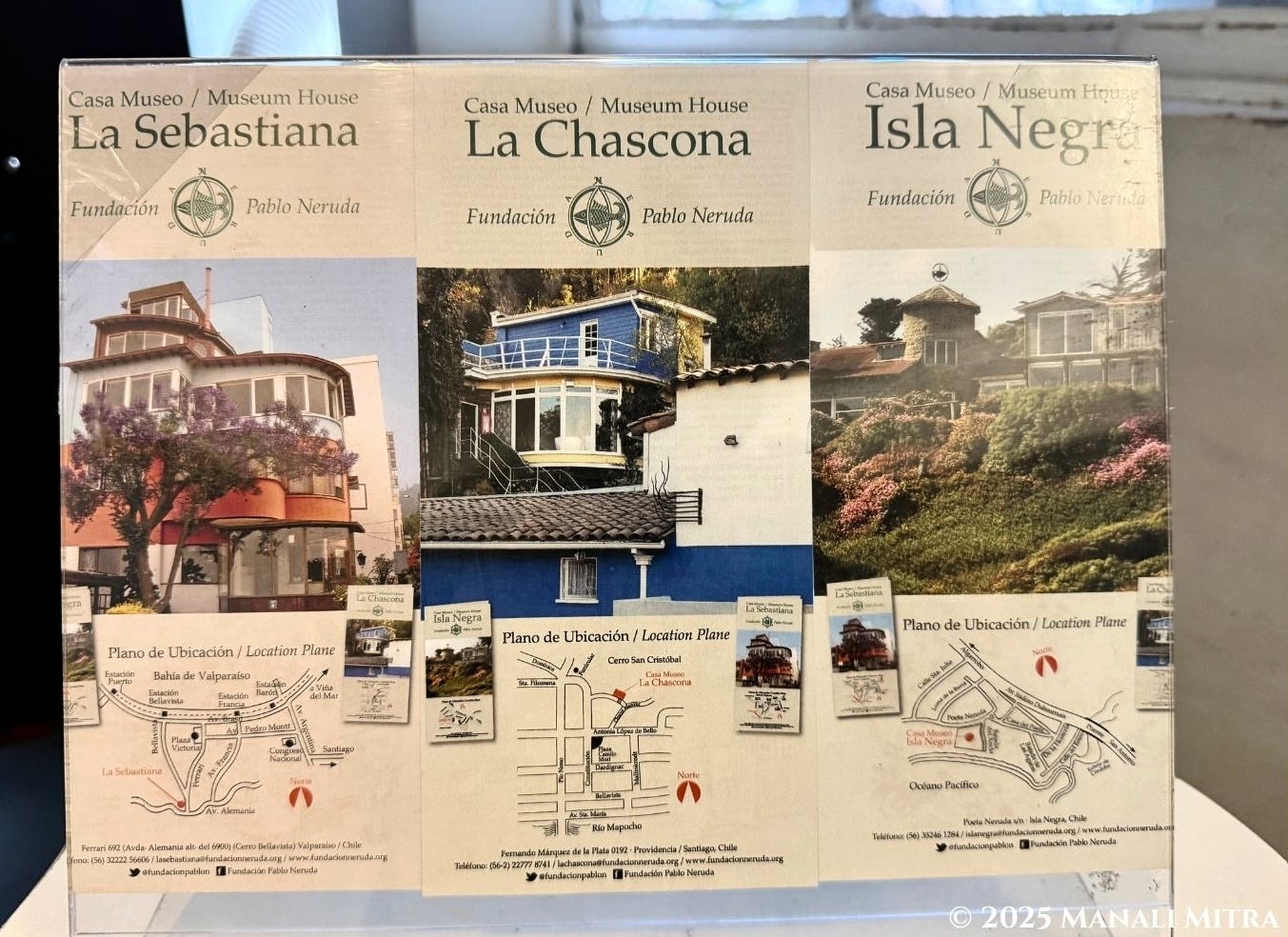
La Chascona is located on the hillside, without much symmetry. Neruda hired German Rodriguez Arias, a Catalan architect, to build all three of his houses. The entrance door’s glass panel displayed the intertwined initials of Pablo Neruda and Matilde Urrutia.
The house, named “Chascona,” is a Chilean Spanish word for “tangled” or “messy hair,” a tribute to the wild red curls of Neruda’s then-secret lover, later his wife, Matilde Urrutia. At the time, their love was hidden from Santiago’s judgmental eyes, and this house was their little sanctuary. Neruda’s obsession with Matilde’s unruly mane is defined in 100 Love Sonnets (1959).
“I don’t have time enough to celebrate your hair. One by one I should detail your hairs and praise them… I call you curly, my tangler; my heart knows the doorways of your hair.”
The architecture of La Chascona also felt like a “tangler,” with twisting staircases whose wrought-iron handrails flowed like waves, leading to unexpected corners. When Neruda saw the blueprints of the house facing the sun, which meant facing the city, he demanded they be turned around so he could face the mountains instead. Neruda wanted a home where the sun would rise behind the mountains, as he wrote, “lighting the high tower of your hair.” Even the window grill design (also the emblem of La Chascona) had motifs of the sun along with flowing forms inspired by Matilde’s famous unruly hair, echoing Neruda’s line, “In Italy they call you Medusa, because of the high, bristling light of your hair.”
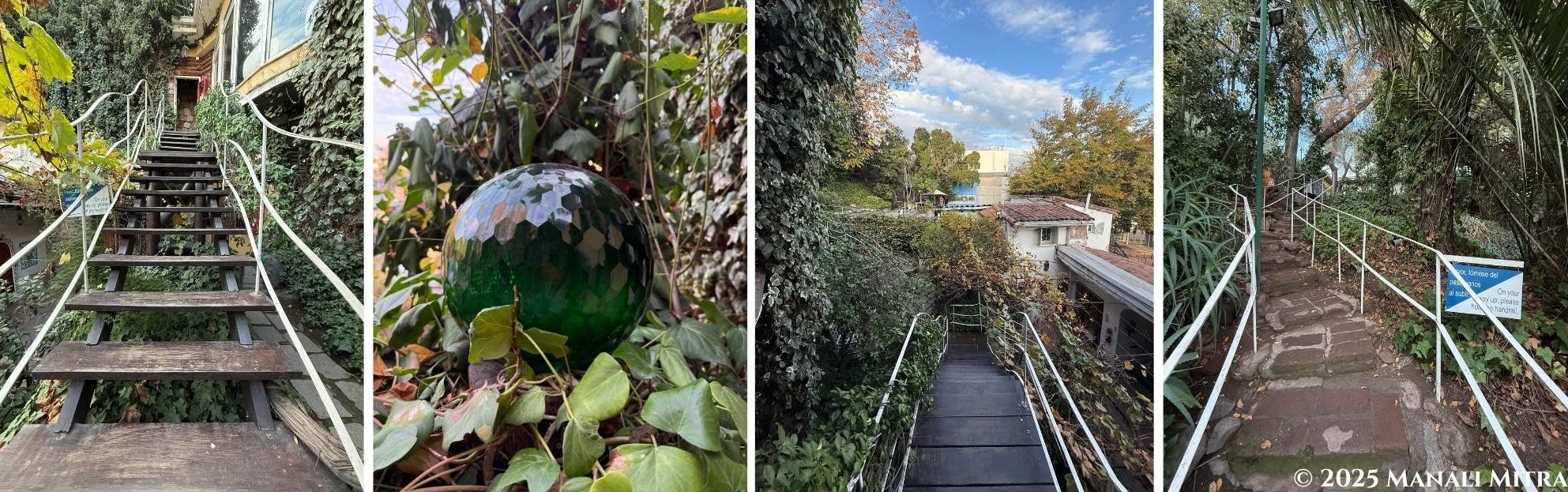
I walked in with the audio guide, fascinated. Taking photos was strictly forbidden inside the house, but allowed outside in the garden. I actually felt an intimacy with the experience as I memorized every little object I saw rather than storing it in the phone gallery.
Even before stepping into the house, the courtyard gave the first glimpse of the man behind it all. The house was wonderfully eccentric, divided into three sections, each having a strong nautical character, with the porthole-style windows that reinforced the illusion of being at sea. Once, there was even a small artificial stream running through the yard outside, so the guests dining would feel as if they were aboard a ship.
I walked around the patio where the walls were alive with murals of fish and birds, and vines curled around the arched doorway. A sudden spiralling staircase, antique glass buoys catching the light, and quirky wrought-iron garden furniture tucked between plants — the whole entrance seemed to be a prelude to Neruda’s creative world inside.

The house is a manifesto of his elemental materialism. He famously explained this obsessive “collecting” in his memoirs:
“In my house, I have put together a collection of small and large toys I can’t live without. The child who doesn’t play is not a child, but the man who doesn’t play has lost forever the child who lived in him and he will certainly miss him. I have also built my house like a toy house and I play in it from morning till night. These are my own toys. I have collected them all my life for the scientific purpose of amusing myself alone. I shall describe them for small children and for others of all ages.”
He was a creature of the tangible, filling his “toy house” with nautical maps, glass buoys, and furniture salvaged from boats. As I entered the “Captain’s Bar”, on the right, a shelf held rows of hand-carved folk figurines Neruda had gathered during his travels, alongside a Fornasetti plate from Italy featuring the face of opera singer Lina Cavalieri. The Czech goblets below added their own splash of color to the display. The bar is a vivid expression of Pablo Neruda’s “ship on land” philosophy, designed with low wooden ceilings and a curved zinc counter to recreate the intimate feel of a maritime cabin.
Multiple vibrant fruit artworks, mostly watermelons, adorned the walls of this cozy galley, validating Neruda’s fondness for the fruit he celebrated in his Ode to the Watermelon, with its hemispheres open, showing their green, white, and red. One watermelon painting that blew me away was a watermelon resting in a bathtub, with a bite taken out, revealing Neruda’s profile. I’m not sure about the artist, but it was gifted to Matilde Urrutia after Neruda died in 1973.
On the dining table, salt and pepper shakers labeled “marijuana” and “morphine” exuded Neruda’s rebellious spirit, and English willow-pattern plates and the colored goblets from Mexico turned the table into a kaleidoscope of color. Nearby, a cleverly designed slim closet served both as a costume cabinet and a discreet passage. Neruda would change outfits mid-meal, surprising guests by emerging as admiral, miner, or pirate to turn dinners into lively theater, and sometimes he’d slip away upstairs using the hidden exit for brief rests during the gatherings!
The bedroom of Neruda and Matilde felt strangely alive, not like a museum room at all. A few personal things of Matilde were lying on the dressing table, making the space feel intimate and private. I didn’t want to stand there for long. I felt I was intruding on something that once belonged only to Neruda and Matilde.
Then I took the staircase through the patio and reached the living room. And Voila! I saw Diego Rivera’s masterpiece hanging on the wall, depicting Matilde with two faces: one as the elegant public singer known to Chileans, the other as the passionate private lover hidden from society during their 22-year affair. Her wild red hair conceals a portrait of Neruda himself, symbolizing their secret bond while he was still married to Delia del Carril.
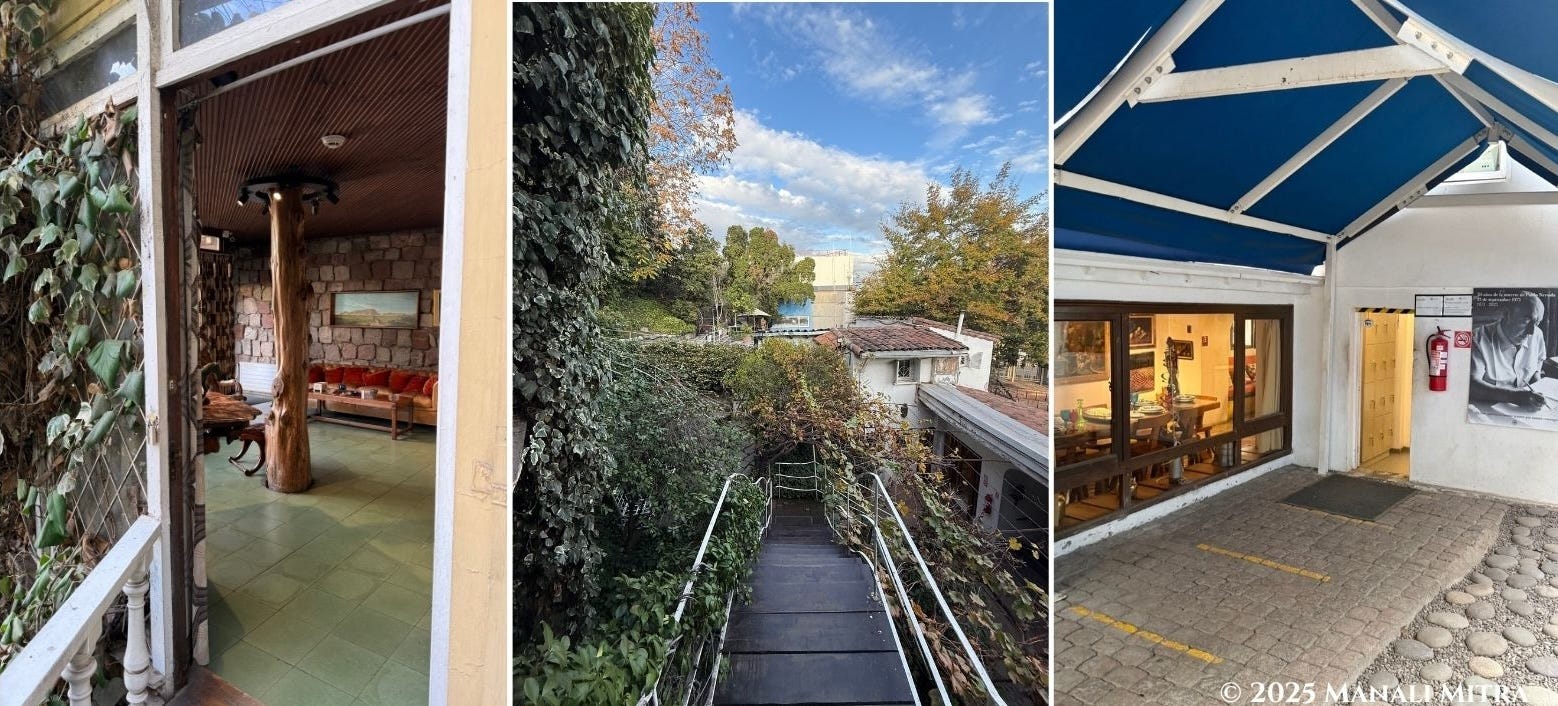
The living room seemed to be held up by a cypress trunk at its center; a Karate lounge chair was kept in front of a huge window overlooking the patio, where the artificial stream once flowed. Nearby were pieces of Piero Fornasetti furniture, African wood carvings, music boxes, stone eggs, and many other artifacts. In one corner, I spotted a vintage Rajasthani embroidered horse, while along the windowsill, rows of glass bottles caught the light. Neruda spent his life celebrating the wonder of ordinary things, which is evident in his Odas elementales. He wrote odes to an onion, to a pair of socks, to a bar of soap, to an Artichoke, to salt and countless humble things, and this house feels like a living expression of that same love for the ordinary made extraordinary.
I climbed down from the living room and then took another flight of stairs up through the garden to reach another patio. The wall there had a mosaic fish by Marie Martner, once a waterfall. Next to it was the Summer Bar, like a cozy covered patio. Neruda used this bar during the warmer months, when evenings were pleasant enough to sit out late into the night. Although stepping inside wasn’t allowed, a glass front allowed a clear view, and I could still spot everything within. Stone walls were lit softly by lanterns and warm lamps. On the floor lay oversized shoes from Neruda’s hometown of Temuco, along with a large wooden fan, both once used by shopkeepers in small towns to show customers what a shop offered, especially in places where many people could not read.
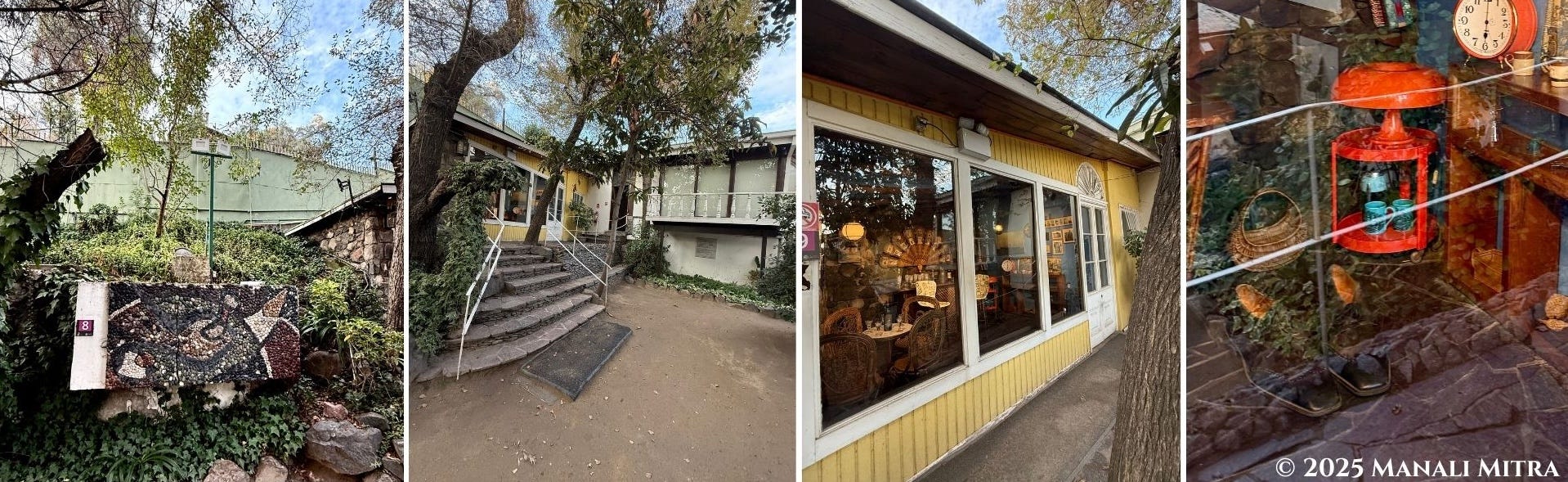
Beyond the Summer Bar lies La Chascona’s first library, a treasure trove where famous matryoshka dolls descended in graduated sizes along the windowsill amid thousands of the poet’s books, while some of his handwritten poems in green and pink ink displayed beneath the glass table.
His library opened into the French Room, with ship-deck floors, nautical paintings, Dutch navigation maps, and his reading chair beside a bright window. The room also displayed his most significant honors: the 1971 Nobel Prize in Literature, the French Legion of Honor, and the Order of Lenin. In this room, I noticed an interesting thread — a map marking many of the significant places the poet had visited. Among them were two Indian cities, New Delhi and Calcutta, from his visit in 1928 to attend the Indian National Congress session. I thought of that teenager in Calcutta, using the Oxford Atlas to trace the latitudes of Neruda’s homes, and realizing he had once walked the streets of mine.
After the 1973 coup, La Chascona was ransacked. Neruda had died just days after Allende’s fall. But Matilde slowly restored the home and lived there until she died in 1985. Today, birdsong and chimes echo through the rooms filled with all his memorabilia.
But if La Chascona was the secret, urban heart of the man, I knew I had to follow the waves to find his soul. I left the “tangled” home of Santiago behind and headed for the coast, for the briny scent of salt — Isla Negra.
© 2026 Manali Mitra. All Rights Reserved.
The chase continues in Part II: Isla Negra. ( Read next post)

 The Unsent Postcard | Travel Stories by Manali Mitra
Leave a comment