Immersed in the interplay of light and reflection in Kusama’s mesmerizing installation

Naoshima Island is a magical place where art, nature, and architecture meet to create an immersive experience. One of the most compelling reasons for my stay on the island was to witness Yayoi Kusama’s celebrated and equally controversial installation, “Narcissus Garden.”
Being an ardent follower of Kusama’s art beyond the Polka Dots and Pumpkins, I had only read about the “Narcissus Garden” but unfortunately missed its exhibit at MoMA by just a few days. My trip to Japan was an exciting opportunity to view this spectacular piece of art, especially when it is installed in a garden designed by renowned Japanese architect Tadao Ando.
“I work with the principal themes of infinity, self-image, and compulsive repetition in objects and forms, such as the steel spheres of Narcissus Gardenand the mirrored walls I have created.” — Yahoi Kusama.
Over the decades, “Narcissus Garden” has appeared in various forms and has an interesting history dating back to 1966. At the Venice Biennale that year, Kusama unofficially participated by installing 1,500 plastic reflective spheres in front of the Italian Pavilion, with signages reading “Narcissus Garden, Kusama” and “Your Narcissism for Sale.” She attempted to sell the spheres for 1200 lira ($2) each, a bold critique of the art world’s commercialization, which led to her expulsion from the show. Since then, this work has been repeatedly exhibited at different venues worldwide and reinvented for decades.
According to art critics, “Narcissus Garden” is derived from the myth in Ovid’s Metamorphoses — “Echo and Narcissus.” In the myth, Narcissus becomes enamored with his reflection in a pond, unable to look away, only to meet his tragic fate. Kusama’s “Narcissus Garden” visualizes the mythical pond, with visitors playing the role of modern-day Narcissus, reflecting on their existence in a sea of mirrored orbs.
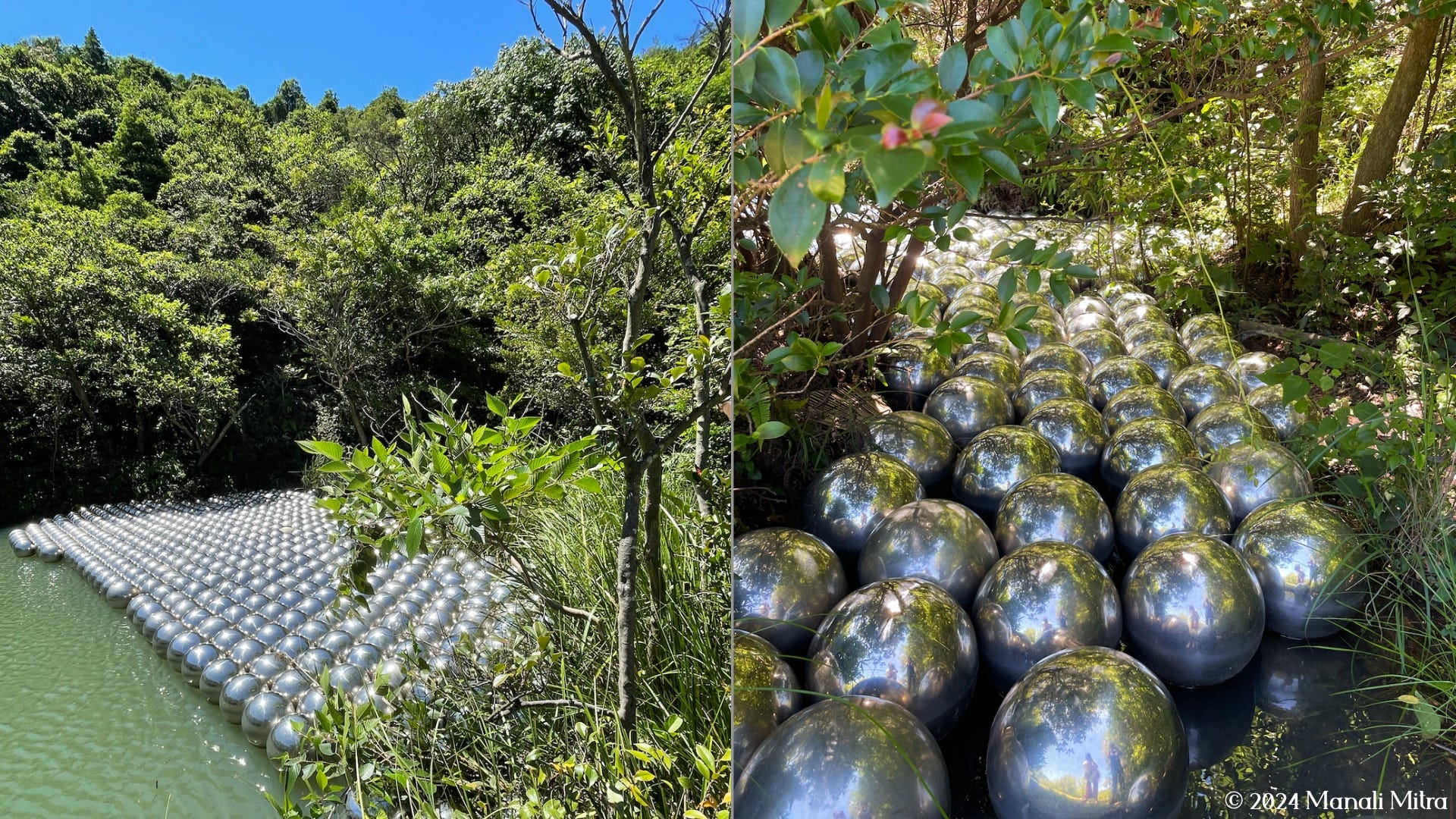
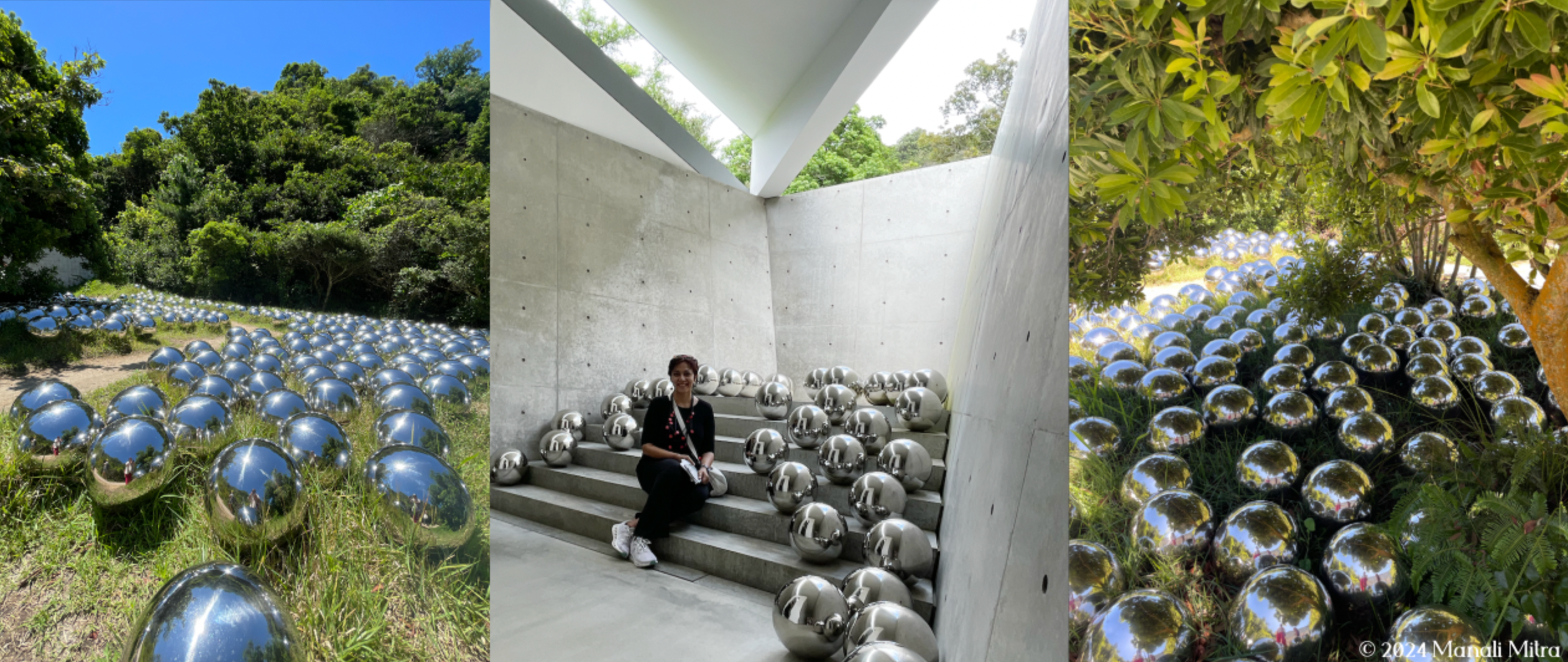
When I arrived at the Valley Gallery in Naoshima island, I was struck by the spectacular sight of 1,700 gleaming orbs — some drifting on the pond, others scattered across the field. These orbs shimmered mirroring the sky’s colors and the surrounding greenery.
As I walked further, I entered a room with pristine white walls encased within a concrete shell. The ceiling, reminiscent of origami folds, added a striking architectural touch. Two angled openings framed the sky, revealing the shifting seasons whether it was the breeze, rain, sunshine, or snow. Inside, natural light illuminated the space, and more steel orbs were artfully arranged throughout the room and along the stairs, enhancing the immersive experience.
I was so captivated by the installation that I returned the following day to experience how the changing light transformed its beauty.

When I bent down and peered closely at the orbs, my reflections appeared fragmented and distorted. Perhaps that was precisely why Kusama chose these spheres to illustrate the disintegration of self that comes with excessive self-obsession.
Beyond the fractured reflections, what enthralled me were the shimmering orbs set against the breathtaking backdrop of nature and the vast blue sky! Each sphere blended seamlessly into the landscape.
This experience reminded me of Paul Éluard’s words, “There is another world, but it is in this one.” What we often call “mystical” experiences are actually these transient glimpses that reside within our own world.
References:
https://www.dailyartmagazine.com/kusamas-narcissus-garden/
https://smarthistory.org/yayoi-kusama-narcissus-garden/
© Manali Mitra 2024. All Rights Reserved.

 The Unsent Postcard | Travel Stories by Manali Mitra
Leave a comment