Part-2

On my second day at Naoshima Island, I woke up to the sound of the waves and with a hangover from the sensory overload of art and beauty from the previous day. I pulled back the curtains and witnessed the most magical sunrise over the water. Being a morning person, I just love Japan’s early sunrises. I decided to take a dip in the sea at Gotanji Swimming Beach, right in front. It was one of those mystical mornings.
The cool water cleared my head, and I sat down with a cup of matcha to write my journal — letting all the art chaos in my head find order on its pages.
Around 9ish, I got ready to go to the Honmura village to get some breakfast and visit the art project.
Honmura is 3 km away, a 30-minute walk from where I was staying. But I got the bus which has a stop right in front of my resort. The bus starts running early on the island. However, I’d recommend renting a bicycle near the Miyanoura port for more flexibility. Since I had luggage and was too engrossed in the art to go back and rent one — I stuck with the bus. Buses are fine, but they run on a schedule so one must keep the timetable handy.
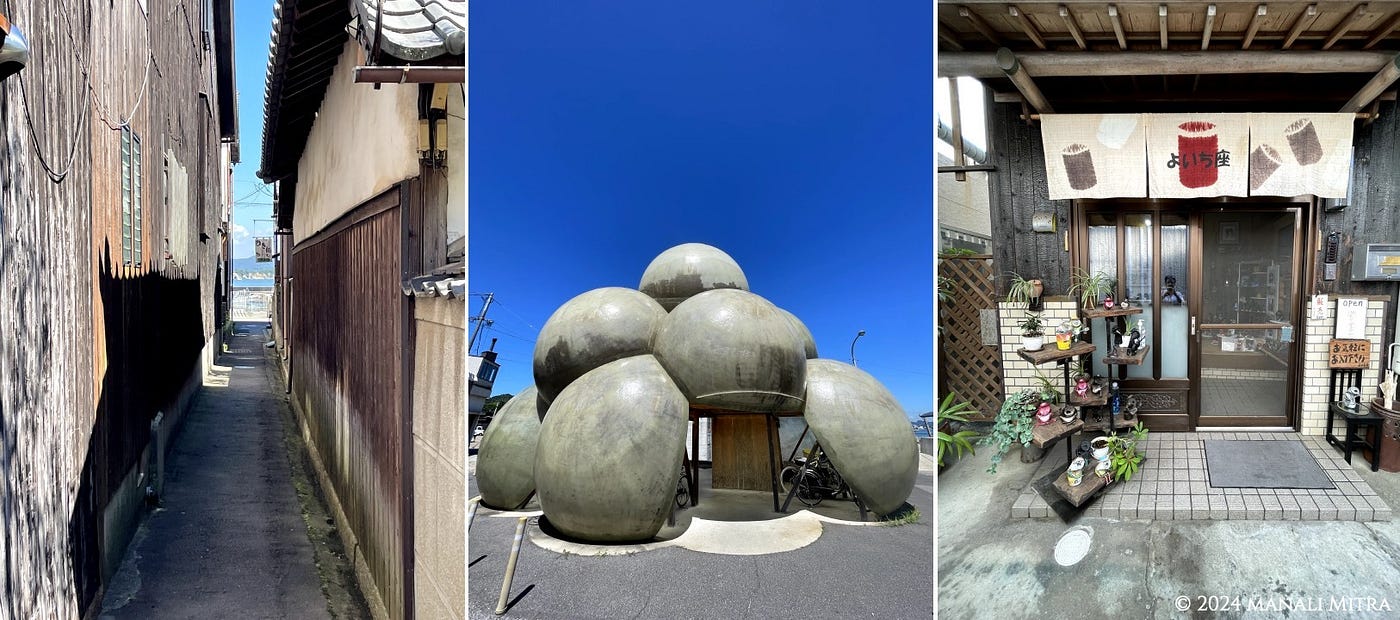
I got off at the Honmura Art House Project — the village was still asleep. Few art pilgrims like me were strolling around. Honmura is a fishing village with roots dating back to the Edo period. The traditional houses have smoked cedar board walls and classic roof tiles. Today, Honmura is a lovely blend of old and new, with hidden art treasures around every corner. The Honmura Art House Project beautifully combines art with its surroundings, converting vacant dilapidated houses, old shrines, and temples into creative spaces. There are seven such unique locations, each with its own story —Minamidera, Go’o Shrine, Kadoya, Kinza, Ishibashi, Gokaisho, and Haisha.
While exploring the village, I spotted a cloud-like structure. That was the Naoshima port terminal — an impressive 8-meter-tall creation built like a cumulonimbus cloud. They are intersecting spheres of fiber-reinforced plastic held up by a wooden frame. The entire island is like an open-air museum — an art lover’s dream.
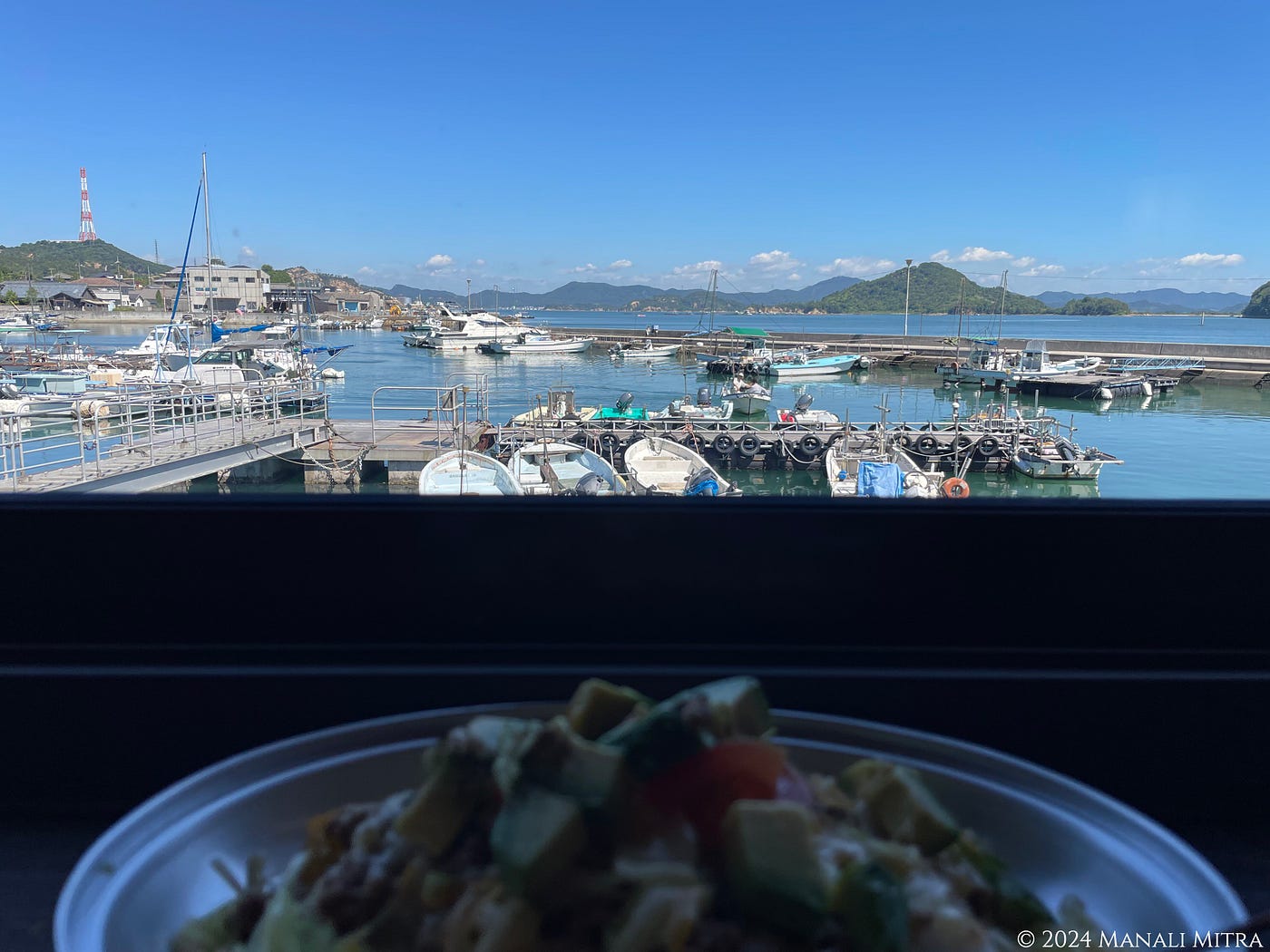
Finally, I found a small cafe that had just opened, serving hot rice with avocado, and seaweed. This cute wooden hut had a cozy window that looked out over the anchored boats and the serene blue sea. I had the perfect brunch before I ventured to feast my senses on more art.
I walked to the Honmura Lounge a few metres away to buy my ticket for the art project. I got one multi-site ticket that covers all the art houses except Kinza. I decided to skip the Ando Museum, and the Naoshima Bathing House due to limited time.
“Light knows when you’re looking at it” — James Turrell
My first stop was Minamidera — the collaboration between the two geniuses James Turrell and Tadao Ando. It is a rectangular building built on an old Buddhist temple, that hosts James Turrell’s other experiential artwork, “Backside of the Moon.”
Only a small group could enter at a time. We were asked to saunter, keeping our hands lightly against the wall as the space would become quite dark and the floor sloped gently downward. The room was overwhelmingly dark and silent. I had to be extremely cautious not to bump into someone in that darkness. My legs brushed against a bench, and we were asked to sit for a while before we could move around. All I could hear was the sound of breathing. Gradually, faint outlines of light appeared on the two walls, slowly coalescing into what resembled a distant screen. We were asked to move around. When I reached out to touch the screen, there was nothing. The light is not a real light but a light that exists beyond the darkness — my eyes adjusted to the darkness!
Soon after, the guide instructed us to leave. The whole experience felt like emerging from the dark depths of Dante’s Inferno into the radiant light of Paradiso. As I mentioned in my Day 1 story about James Turrell’s “Open Field;” it’s impossible to put the experience into words — one has to be present physically to feel the magic.
I can say that this will remain one of my all-time favorite art experiences.
“There are no rules and I can do anything. I do it when I like to do it” — Shinro Ohtake

My next stop was Haisha (translated as Dentist)— which used to be a dentist’s office. Now it has been turned into a quirky work of art by artist Shinro Ohtake. The entire house has been stripped down and transformed into his wild imagination, using everything from scrap ships, rough wood, rust, glass, neon signs, and steel towers to create his work “The Dreaming Tongue.” With his use-of-scrap sensibility, he created this eccentric and beautiful experience.
One has to remove their shoes before entering this house and photography is restricted, much like in many of the Honmura art projects.
Inside, from the floor to the ceiling, the space is an eclectic mix of collected ephemera — magazines, postcards, personal letters — interspersed with vibrant, abstract murals. The dentist’s waiting room seemed as if it hosted a wild party, with all its papers, letters, and magazines now dancing across the walls. One room has the Statue of Liberty, thrusting through the floorboard. Another room with the human-sized alcoves was oddly unsettling. The place is eccentric with a captivating charm.
Ohtake also designed the nearby bathhouse “I Love Yu” (2009), just a short stroll from Miyonaura port.
“With the development of science and technology, we humans are under the illusion that we can do anything and are trying to manipulate nature at will. But nature and the universe behave in unpredictable ways” — Tatsuo Miyajima
The Art House Project Kadoya, a 200-year-old Japanese house, hosts Tatsuo Miyajima’s “Sea of Time ’98”. Imagine walking into a room where the floor is covered in glittering water with LED lights on the surface. Every time someone new comes into Kadoya, the water ripples and the lights flicker!
The installation has 125 digital counters with red, yellow, and green LED lights blinking briefly from 1 to 9, then going blank before starting over. In 1998, Miyajima invited 125 Naoshima residents, aged 5 to 95, to set the counters’ paces — they set the speed of the timers, which represents the lives of the locals in that room. It was a rare collaboration between the artist and the Naoshima residents. This process helped the locals embrace the artwork as part of their community — was significant for integrating art into their everyday life.
In 2018, the artwork was revisited — which involved tracking down the original participants or their families to reset the counters. As Naoshima is a small island with a close-knit community, finding the original participants was relatively easy. Though it took almost two months to locate the last 20 people. The 2018 participants included some of the original members, their families, and 19 new residents, highlighting the island’s growing diversity. The new digital counters have advanced LED technology, making them brighter and slower, changing the overall impression of the installation.

“Time-Setting 2018: Succession” explored how art can remain relevant over time through community involvement. This was only possible after twenty years with the help of Naoshima’s residents, who brought the artwork to life. During the 2018 gathering, reportedly some folks were already talking about “the next gathering,” imagining another twenty years for themselves and the artwork to stick around.
“Time-Setting 2018: Succession” made “Sea of Time ’98″ timeless.
Ishibhasi project was once the home of the Ishibashi family, who made a fortune in salt. This place was renovated to preserve Naoshima’s history and culture. It took artist Hiroshi Senju five years to complete. Senju is famous for his large-scale monochromatic depictions of waterfalls. Ishibashi houses “The Falls,” one of Senju’s iconic paintings in a darkened room with just a few slivers of natural light. At first glance, it looks like water is flowing down the wall. It’s one of my favorite artworks I’ve experienced.
“When I paint, I begin by listening carefully. I am trying to discover which way the waterfall wants to flow, what form it is trying to take. I spend time engaged in this silent dialogue, looking at the washi paper before me without painting at all. As I paint, the image in my mind gives way to the real waterfall I am painting, which is now so much stronger that at times the original image slips away.” — Hiroshi Senju
“The Garden of Kū” is another masterpiece by the artist in misty gray-black tones on the paper sliding doors, inside the main building.
The Go’o Shrine is a restored Edo-period shrine by Japanese photographer and architect Hiroshi Sugimoto — he revamped the shrine where the local deity, Ujigami of Honmura district in Naoshima is worshipped. The main shrine and the underground rock chamber are connected by a glass staircase that makes the underground and overground feel like one.
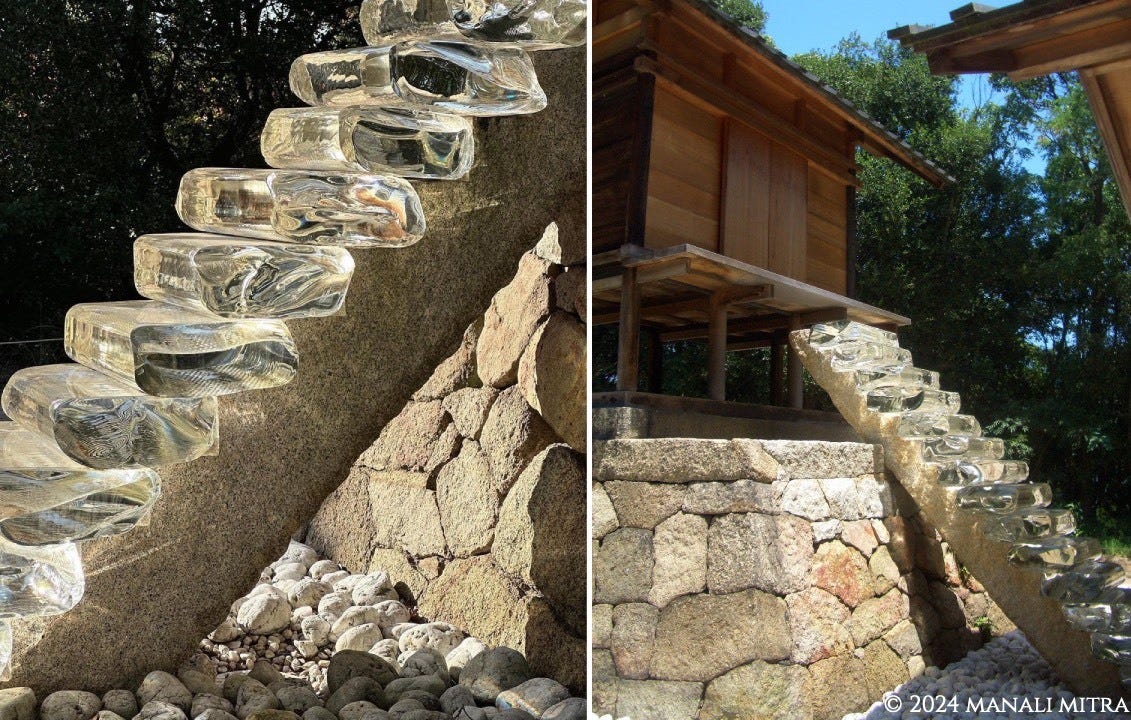
Sugimoto believes that Gods should reside in a well-pruned space without any gaps, which inspired the name “Appropriate Proportion.” Built with simple materials like wood, stone, and glass, the shrine, along with its surroundings, creates a minimalist aesthetic. I was blown away by this project. Later saw a miniature of this shrine at the Hiroshi Sugimoto Gallery.
It was already past 1 p.m. After witnessing Go’o Shrine, I knew that I could not miss Hiroshi Sugimoto Gallery: Time Corridors near the Bennesse Hotel. I got the bus in time and headed toward Sugimoto Gallery.
“I’m inviting the spirits into my photography. It’s an act of God.” — Hiroshi Sugimoto
As I walked into the Hiroshi Sugimoto Gallery, the space gradually darkened as I descended the stairs, creating an atmosphere of mystery that hinted at something extraordinary ahead. In this dimly lit space, illuminated only by a soft bluish-white light, the photographs came alive in a way I hadn’t anticipated. Another work of brilliance by architect Tadao Ando.

On my immediate left was the Pine Trees, 2001.
Hiroshi Sugimoto saw Hasegawa Tohaku’s “Pine Forest Screens”(circa 1590) from the Momoyama period. The way Tohaku used light and shadow naturally resonated with Sugimoto’s love for black-and-white photography. In Japanese tradition, Honka-dori, or “taking up the melody,” celebrates learning from great masters. Sugimoto embraced it using Tohaku’s work as inspiration for his own “ink photography.” He traveled across Japan to famous pine sites like Miho no Matsubara, Matsushima, and Ama no Hashidate, all of which were slowly affected by modernization. It was at the Imperial Palace, with its manicured nature, that Sugimoto finally found the pine image he’d been searching for. After closely observing the trees’ graceful shapes, he created an imagined pair of six-paneled screens. The result is a “painting” made from photographs — a blend of real and imagined landscapes, much like Tohaku’s original work.
Apart from his seascapes, I was blown away by Past Presence 070 (2016), Hyena-Jackal-Vulture (1976), and Church of the Light (1997).

As I stepped outside, I found the famous “Glass Tea house Mondrian,” nestled in nature. The tea house has traveled from Venice to Versailles to Kyoto, and now it has found its perfect home on Naoshima Island. Hiroshi Sugimoto’s Glass Tea House Mondrian is a stunning work inspired by the 16th-century Japanese tea ceremony of Sen no Rikyu. It was Sugimoto’s first architectural project in Venice, featuring a floating glass cube within a reflecting pool and a glass mosaic by Bisazza. Visitors can walk along a path of custom ceramic pavers to a viewing area and watch the tea ceremony performed inside the cube. Now, the installation has found its stunning home on Naoshima Island, beautifully set against the backdrop of the blue sea and a waterfall.
The gallery’s tea room is charming. I was pleasantly surprised when, while ordering the matcha, they asked to see my ticket and served me the matcha and mochi on the house. The treats come complimentary with the ticket, which I had overlooked, and it was thoughtful of them to remind me.
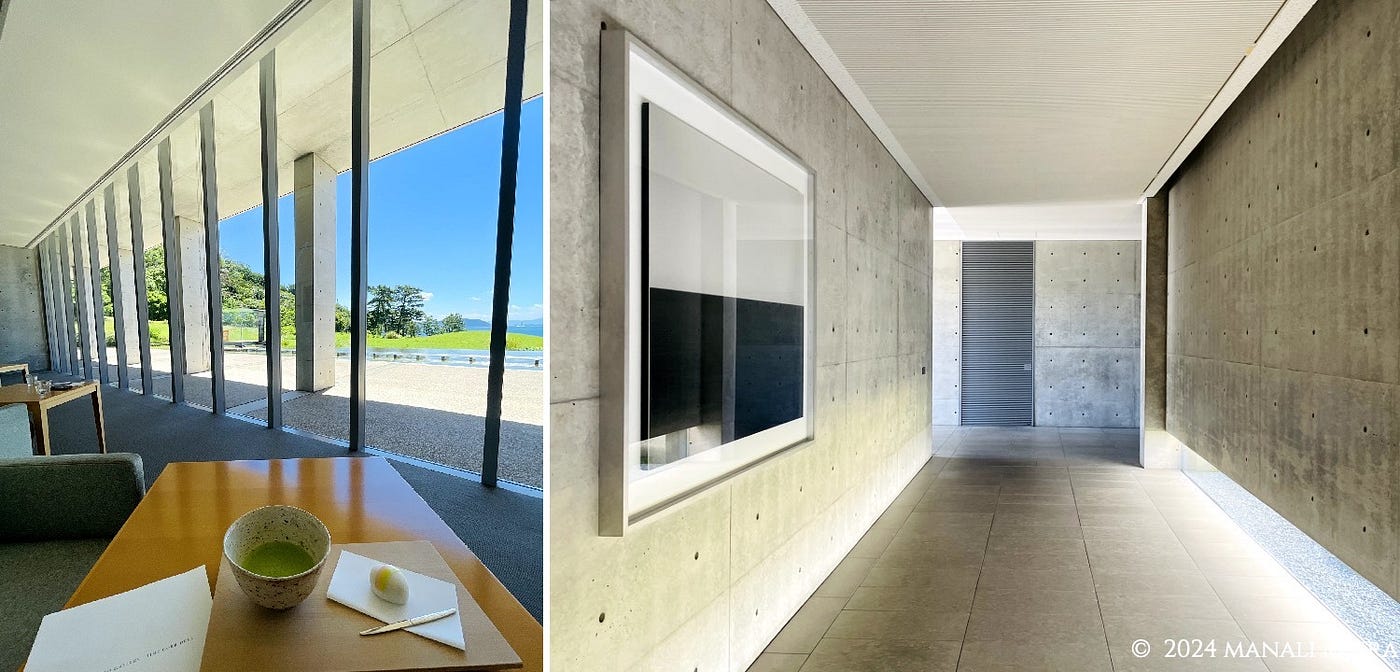
Before stepping into the Lee Ufan Museum, my final destination for the day, I couldn’t resist another peek at the Valley Gallery next door to soak in Kusama’s mesmerizing Narcissist Garden — those gleaming silver orbs capturing light like scattered reflections of the sky.
There’s something magical about revisiting art — it felt like I discovered a new layer, a hidden nuance I hadn’t noticed before.

“When the artwork feels like a living thing, that’s when I let it go” — Lee Ufan
Lee Ufan is a Korean-born, Japan-raised minimalist sculptor. The way to the museum is a gentle slope to a grassy area with a concrete path cutting through it. Adjacent to the path is a sleek metal slab standing upright, flanked by two large rocks. At the end of the path, there’s a cemented open space with another metal plate on the ground, another rock, and a tall, plain pole. These straightforward elements come together beautifully creating an interesting contrast. Lee Ufan once stated in an interview, “We believed that the unmade needed to be introduced, rather than something that was made. To give you an example, a rock, a natural stone, is not made, but can be as old as the earth. So in an effort to break away from the conventional way of thinking that concentrated solely on making and looking at things anew, we asked: how does bringing in the unmade open up a new dimension of expression and change both the made and the unmade? That movement became Mono-ha.” Lee Ufan is one of the pioneers of the Mono-ha movement.
My favorite was “Porte vers l’infini”(Door to infinity). His inspiration for this work dates back over thirty years. After a meeting at a folkcraft studio in Matsumoto, Lee Ufan was walking on a country road along a small historic street lined with white-plastered storehouses. The rain had just stopped, and a small rainbow appeared in the distance, captivating him with its beauty. Despite the impression it made at the time, the memory of the rainbow faded. It was while wandering through the garden of the Palace of Versailles that the idea of creating a rainbow structure there resurfaced.
Torii gates in Japan are important symbols at Shinto shrines, and walking through them has been meaningful for a long time. In everyday life, people also pass through metaphorical gates that offer new insights. Lee believes if one walks beneath Porte vers l’infini, he/she encounters a sense of infinity through the vast expanse of the sky, the refreshing sea breeze, or the museum’s integration with the mountainous landscape.
I also loved “ Dialogue” which consists of three oblong brushstrokes — Lee’s art reflects yohaku, or empty space. This method relies on the resonance between the painted and unpainted areas. The colors are single brush strokes, and have simple forms that highlight the surrounding white space. For Lee, these ‘blank’ areas are essential, allowing the boundaries between the paintings and the space they occupy to merge, creating an ongoing “dialogue” between each piece.
Even though my visit to the Lee Ufan Museum was rushed, I’m really glad that I went to witness Lee Ufan’s use of yohaku and Tadao Ando’s (yet another) clever design. The experience was an eye-opener — Lee Ufan invites you to see the unseen and notice the subtle details that often elude us.
As I wrapped up my two-day journey at Naoshima, I felt a bittersweet rush — so much art and beauty, yet too little time to fully take it all in. A week would have been a dream, immersing myself deeper into all the art and the tranquil sea.
The sun was setting casting a warm, wistful glow over the island as I picked up my luggage from the reception. I headed to the Miyanoura port to catch the ferry. Missing out on Teshima and Inujima islands stung a little, but I was thankful for being able to experience the two magical days at Naoshima. Leaving felt like parting with a piece of myself. I’m already longing to return and experience its magic all over again.
“You use a glass mirror to see your face; you use works of art to see your soul.” — George Bernard Shaw

© 2025 Manali Mitra. All Rights Reserved.

 The Unsent Postcard | Travel Stories by Manali Mitra
Leave a comment