Part-1
“Art enables us to find ourselves and lose ourselves at the same time.” — Thomas Merton
The ferry approached Naoshima —once a fisherman’s village and now Japan’s art island, through the crystal blue waters of the Seto Inland Sea. I could spot the “Red Pumpkin” installation; it looked like a tiny dot of red delight from far away!

This little island with approx. 3000 residents attract art lovers from across the globe because of its contemporary museums and art installations scattered around the island.
As soon as I got off the ferry at the Miyanoura Port, Yayoi Kusama’s “Red Pumpkin” welcomed me up close. A short walk away was the futuristic installation by Sou Fujimoto, “Naoshima Pavilion” — an interesting contrast to the dotted Pumpkin’s whimsy.
Nearby, the polka-dotted Naoshima bus was waiting to take the travelers to the village and I hopped in. The bus made its way through Honmura, the charming village with tiny meandering lanes, wooden houses, and well-preserved architecture.

The last stop — The Tsutsuji-so bus stop, was right by the water’s edge where my resort, a quaint Japanese inn by the sea was located. That was the Gotanji Bathing Beach, with a Torii gate at the entrance — perfect for a swim.
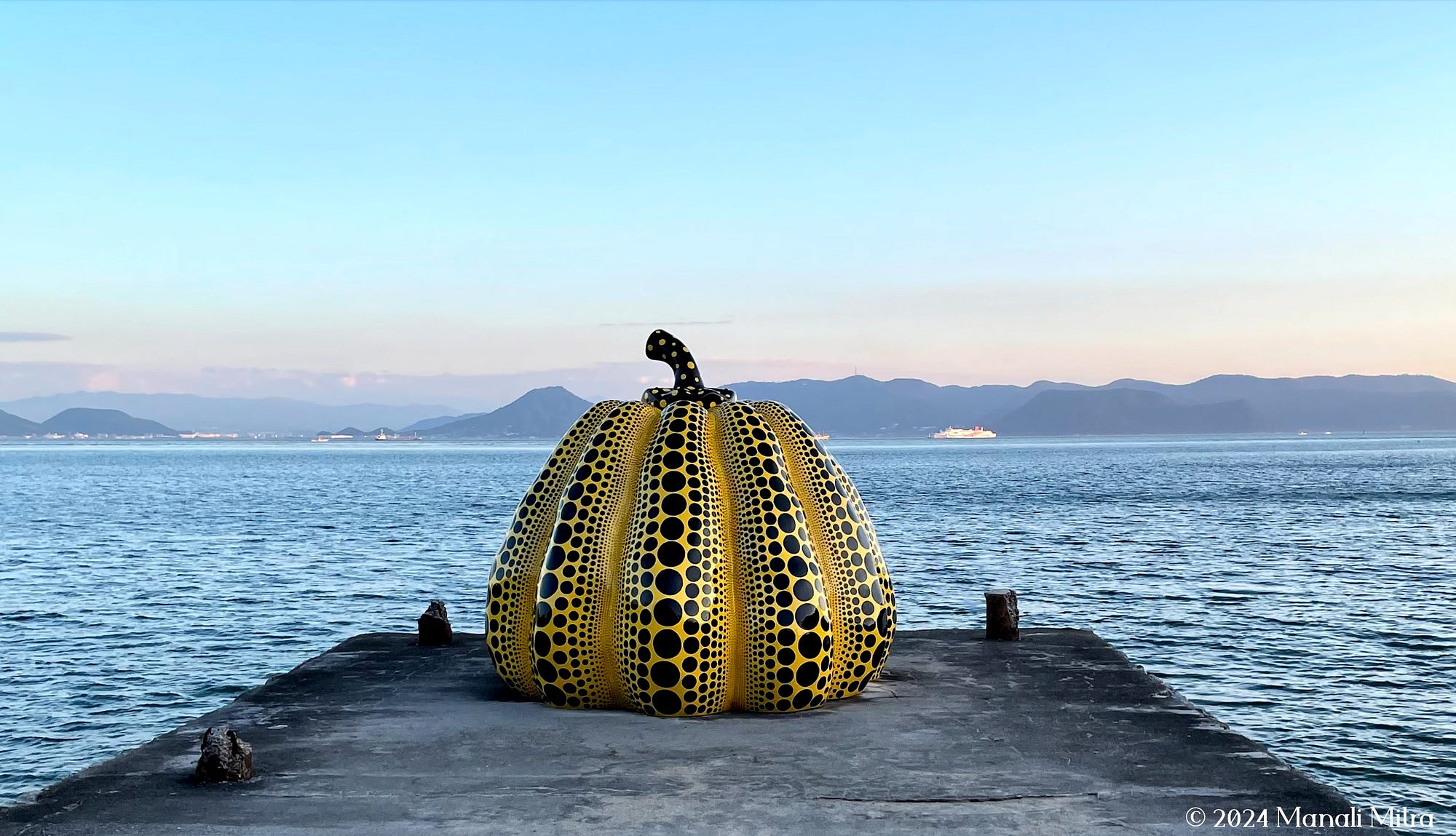
Yayoi Kusama’s iconic “Yellow Pumpkin” installation was just a few meters away.
“With just one polka dot, nothing can be achieved. In the universe, there is the sun, the moon, the earth, and hundreds of millions of stars. All of us live in the unfathomable mystery and infinitude of the universe. Pursuing ‘philosophy of the universe’ through art under such circumstances has led me to what I call ‘stereotypical repetition.” — Yayoi Kusama
Kusama’s signature pumpkins and polka dots are everywhere on the island — not just as installations; but they are on the bus, the ferry, in cafes as little decorations, and even inspired a dessert at the museum café with pumpkin and ice cream!
As a Yayoi Kusama fan, I was loving every bit of it!
I had arrived early at the resort, having taken the 7 a.m. Shinkansen from Kyoto to Okayama. From Okayama station, I took a bus to Uno Port, where ferries frequently shuttle to the island, getting me there by 10. The journey might sound like a maze, but it is quite straightforward.
As it was too early to check in, I dropped my luggage at the reception, grabbed a map, and set off for the Benesse Art Museum. There is a free shuttle bus that operates between Tsutsuji-so and Chichu Art Museum, with brief stops at the Benesse House Museum, Valley Gallery, and Lee Ufan Museum all within a kilometer and a half. But I decided to walk and take in the island’s charm.
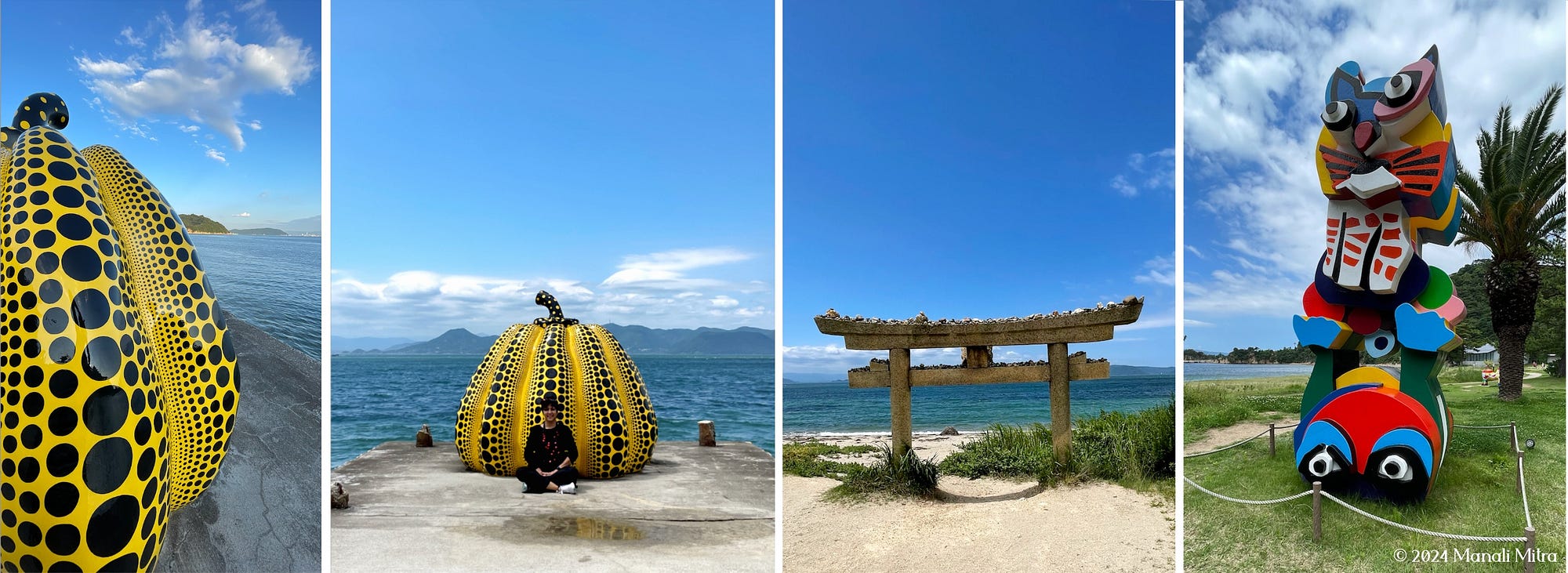
“Yellow Pumpkin,” Naoshima’s showstopper is beautifully set against the stunning landscape. Since I was staying just a few meters away, I frequently visited to energize myself with the sight of the bright yellow pumpkin against the pristine blue sea. Talking about pumpkins, Kusama once said, “I was enchanted by their charming and winsome form. What appealed to me most was the pumpkin’s generous unpretentiousness. That and its solid spiritual base.” Standing in its shadow, I felt her words firsthand. The most magical time is early in the morning when one can quietly sit, listen to the waves, and immerse in this energizing view.
Interestingly, in August 2021, a typhoon toppled the sculpture into the sea. By 2022, it was reinstated with a tougher shell.

Most of the galleries on the island are designed by the famous Japanese architect Tadao Ando. Known for his innovative use of natural light, the architectures are bathed with natural light throughout the day that blends beautifully with the landscape.
While walking to the Benesse Art Museum, I got sidetracked by a bunch of cool installations — the Benesse Park with its lush green slope is dotted with artworks by French artist Niki de Saint Phalle.
And at one corner, stands the sculpture by Dutch artist Karel Appel, “Frog and Cat”— the inaugural installation since the inception of the Benesse Art Site Project.
The Benesse Art Site Project began in 1989 with the launch of Naoshima International Camp on the island. Under the guidance of Tadao Ando, the site had the traditional Mongolian yurts for overnight stays and the sculpture “Frog and Cat “by Karel Appel. This camp triggered the idea of the Benesse Art Site Project blending education and culture to build an art community by displaying art amidst Naoshima’s natural beauty.
Opened in 1992 and designed by Tadao Ando, the Benesse House Museum is like a genius fusion of nature, art, and architecture, combining a museum with a hotel. Unlike the Chichu Museum, this building is above the ground. If you want to stay at the hotel, book well in advance, as most rooms sell out quickly. I was keen to stay at the Oval, but with only six rooms, it was fully booked. However, I had no regrets once I saw my accommodation.
“Mystery of mysteries, water and air are right there before us in the sea. Every time I view the sea, I feel a calming sense of security, as if visiting my ancestral home; I embark on a voyage of seeing.” — Hiroshi Sugimoto
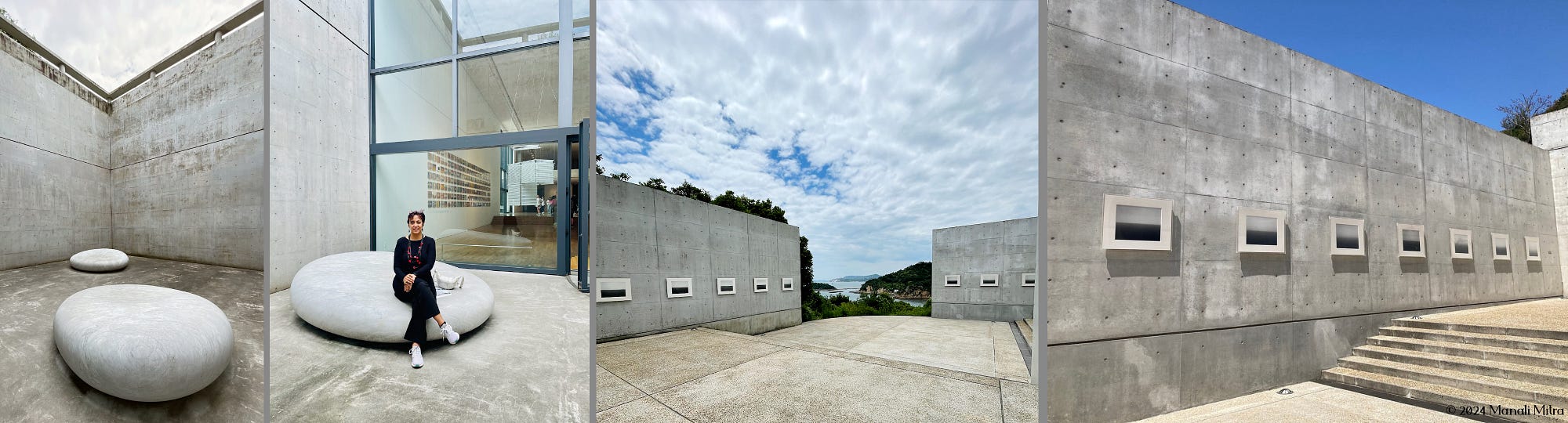
In the courtyard of the Benesse House Museum, Hiroshi Sugimoto’s ‘Time Exposed’ series is displayed on the walls. In 1980, Sugimoto began the project of photographing the sea and its horizon across the world, experimenting with various exposure times. His photos capture clear days with sharp horizons between bright skies and dark water; foggy days where sky and sea merge; night scenes with different shades of black; and dawn shots taken out of focus. The real sea view alongside these photos makes the experience truly breathtaking.
An interesting fact: Sugimoto’s seascapes inspired Bono’s No Line On The Horizon.
“The Secret of the Sky” by Kan Yasuda (1996) is an outdoor installation — two gigantic polished stones resembling cushions, enclosed by high concrete walls. You can sit or lie on these stones and gaze up at the sky — a perfect spot for sky gazing. Interestingly, a prolonged stare during the daytime was unsettling, possibly due to the sun. The museum offers multiple entries and is open until 8 pm, so I returned in the evening to lie down and gaze. If one is staying at the Benesse Hotel, there is access till 10 pm — a great way to spend the late evenings!

“The World Flag Ant Farm” by the Japanese artist Yukinori Yanagi created world flags from vibrant sand within a network of interconnected plexiglass boxes, letting the live ants freely move around the terrains. As the industrious ants burrowed through the sand, they inadvertently fractured the flags, causing the colors to mix and the flags to slowly disintegrate.
The ants’ symbolic journey across sandy borders tells a profound story of national identity and cultures globally. As the ants tirelessly transport food and sand within the system, the sands gradually transform over time, breaking down the divided barriers into a nuanced blend of flags. I loved this fascinating blend of art and nature and how the smallest of creatures can work together to create something so big and impactful.

“100 Live and Die,” 1984 is Bruce Nauman’s greatest work with many dichotomous words, cry and live, live and die, laugh and die, play and die to depict the paradoxes of life. He used neon lights to show the interplay of 100 words, filling the space with pulsating colors and energy. The installation can provoke a spectrum of emotions — sad and at the same time hopeful. When all 100 words lit up together, it was beautiful and at the same time, overwhelming! And, I spotted my fav — RISE and LIVE.
Singaporean contemporary artist Amanda Heng’s “Always by My Side”(2023) is drawn from her “Another Woman” series. This intimate artwork highlights the bond between mother and daughter that is often unacknowledged. The artwork poignantly captures Heng’s journey into her senior years while tenderly caring for her mother — beautifully portraying the mother-daughter connection in everyday moments. I deeply resonated with this artwork.
There are some notable works like Yukinori Yanagi’s “Banzai Corner” (1996), Jean-Michel Basquiat’s “Gua-Gua” (1984), Richard Long’s “Inland Sea Driftwood Circle” (1997), and Pannaphan Yodmanee’s “Aftermath” (2016). The list could go on. By the time I wrapped up, it was nearly afternoon, and I was starving!

I headed to the cafe for lunch. The pasta hit the spot, and the dessert was out of this world — not because it was Kusama-inspired but the pumpkin and ice cream combo was delicious!
The view from the cafe was stunning, with more art installations in sight. On the museum terrace stands “Shipyard Works — Bow with Hole” by Japanese artist Shinro Ohtake. Another work of his, “Stern with Hole” (1990), is by the beach. Ohtake is famous for his scrapbook method and his ability to uncover the subtle atmosphere or Kehai, behind the abandoned objects and places.
“A bath refreshes the body. Tea refreshes the mind.” — Japanese Proverb.
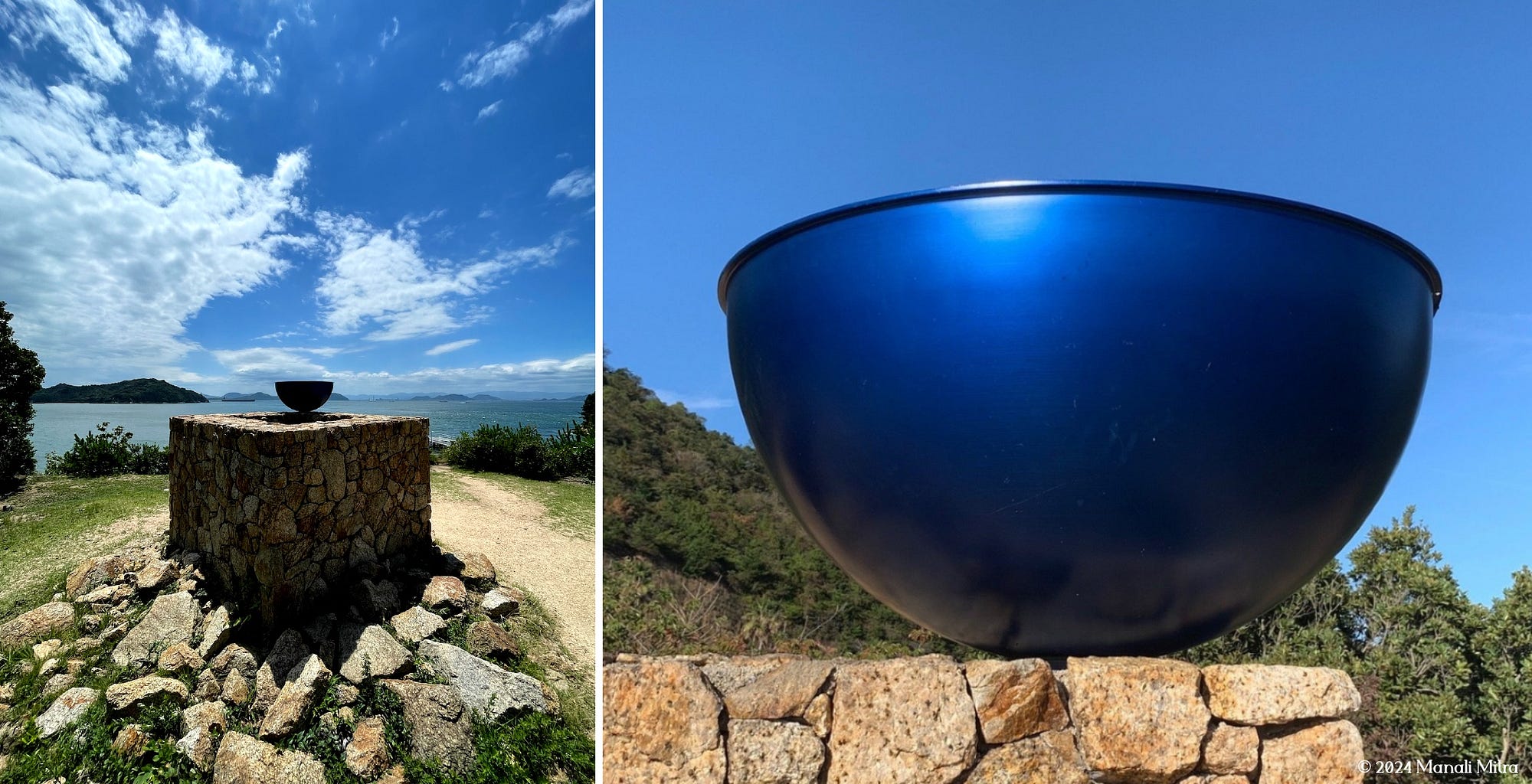
A stunning outdoor piece, Kazuo Katase’s “Drink a Cup of Tea” (1987–94) is perched on a hilltop with a breathtaking 180-degree view of the sea. The granite stone wall is crowned with a blue aluminum tea bowl that harmonizes beautifully with the landscape. The name is inspired by an ink drawing by the famous Zen monk Sengai, that shows a circle and the phrase, “Eat this and drink a cup of tea.” This installation was the first sight for visitors arriving on the island from the pier below Benesse House (which is currently not in use,) inviting them to enjoy a cup of tea. Kazuo Katase himself chose the perfect location for this installation.
The seaside gallery also houses Walter De Maria’s “Seen/Unseen Known/Unknown” — which consists of two hefty granite spheres and some shiny gold bars on the side. The static spheres make a distinct contrast to the constantly shifting view around them. When I stood between the two granite pieces, I couldn’t see the gold bars. As I moved around, new perspectives showed up revealing parts of the installation that were previously hidden. It was my movement that created this fun back-and-forth with the fixed structures. Amazing!
“Three Squares” by George Rickey stands along the pathway from the hill with the seascape on the left. At the top of the slope is the Benesse House Museum, with a shuttle bus stop right in front.
It was time to visit the Valley Gallery which closed at 4 p.m. I spotted the shuttle and hopped on, excited to see Kusama’s “Narcissus Garden,” one of the main reasons for my visit to Naoshima.
The Valley Gallery features Yayoi Kusama’s famous work, “Narcissus Garden,” where 1,700 shimmering orbs float on the pond and are scattered across the landscape designed by Tadao Ando. These gleaming spheres mirror the sky’s colors and the lush greenery, creating a surreal landscape.
I’ve dedicated a story to this captivating masterpiece.
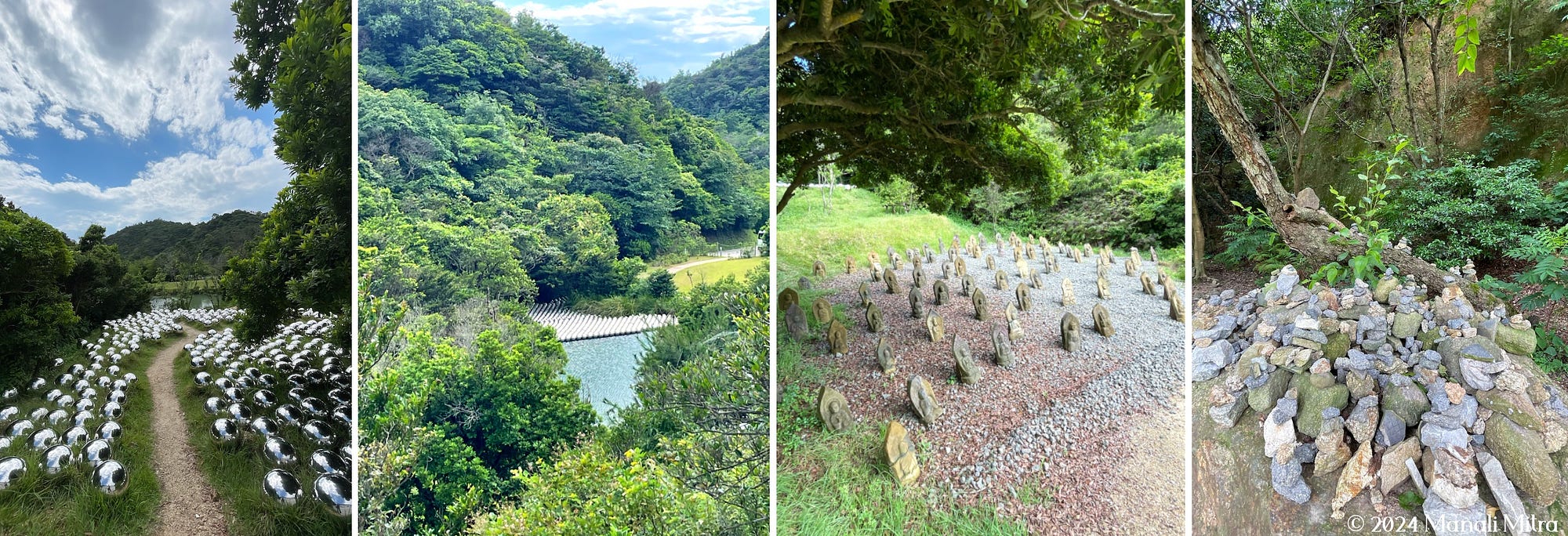
Japanese artist, Tsuyoshi Ozawa’s “Slag Buddha 88” is by the pond, where he crafted statues using slag from the illegal dumping of industrial waste on Teshima. Ozawa took inspiration from Buddha statues created during the Edo period at 88 locations around Naoshima, following the “Shikoku Pilgrimage of 88 Places.” Ozawa delves into the unique aspects of local cultures and the connections between fine art and folk art.
On the other side of the pond, Ozawa incorporated “stacked stones” that tell the story of primitive nature worship inviting visitors to engage with the artwork as if participating in a quiet ritual.
Valley Gallery is an immersive place where Tadao Ando’s landscape blunges beautifully with art building a spiritual aura. I was so blown away that I had to return the next day!
It was 4 PM, so I decided to squeeze in a visit to the Chichu Museum before heading back to my room.
Thankfully, I had the shuttle bus timetable handy and caught the shuttle just in time for the Chichu Museum.

Chichu Art Museum architecture is a masterpiece designed by Tadao Ando. It is the home to the works of Claude Monet, James Turrell, and Walter De Maria.
Chichu in Japanese means “deep within the ground” — like an exquisite gem hidden beneath the surface, the museum is cleverly built underground to preserve Naoshima’s stunning scenery! Despite its subterranean setting, the museum is flooded with natural light, illuminating the artworks and the ambiance with the changing times of day. But I wondered how the underground concrete space instead of being dark and cramped is so airy and filled with natural light! Now, that’s Tadao Ando’s architectural brilliance.
The museum is just a stone’s throw from the reception. As I walked toward the museum, I wandered through a lovely recreation of Monet’s garden at Giverny. Monet’s famous words, “I must have flowers, always, and always,” lingered in the air setting the stage for the masterpieces that one is about to experience.
Photography is strictly prohibited in this museum.
Walter De Maria’s “Time/Timeless/No Time” from 2004 is a mammoth black granite sphere positioned in the center with golden rectangles lining the walls. The whole space is illuminated by changing natural light. With Ando’s genius design, thin beams of light shift across the gallery, making it feel like a giant sundial. No matter when one drops by, it gives a different vibe even if one comes back five minutes later. I returned to experience it for real!
“I’m interested in the light that we see, but also the light that we don’t see.”— James Turell
The above quote by Turell sums up his artistic vision. James Turrell is all about exploring how light affects our perception and experience. While most of us focus on the light we can see, he nudges us to look deeper — to discover the hidden aspects of light that shape how we understand the world. Through his amazing installations and immersive experiences, Turrell triggers us to rethink what we see, encouraging us to appreciate the unseen beauty of the light that’s always around us.
In one of his striking installations, “Open Sky,” I stepped into a small room and sat on a bench against one of the grey walls. The silence made everything feel still. I looked up and spotted the small rectangle cut out of the ceiling that revealed the sky above and a few feathery clouds lazily drifting by. The enclosed space helped me zero in on the sky, allowing me to appreciate its beauty in a way I wouldn’t have noticed otherwise.
James Turrell’s other installation “Open Field” is hard to describe because the real mojo happens when you’re physically there. You walk up some steps and see what looks like a blue square, which is actually an opening to another space lit by blue light. Once inside, the lighting changes, creating optical illusions about the space. It’s hard to grasp how big the space is. The staff is around to politely stop you when you try to walk further, thinking there’s more space to explore. It was mind-bending and at the same time a psychotropic experience!
After soaking in Turrell’s surreal installation, it was finally the moment to witness Claude Monet’s “Waterlilies.”
Walking into the Claude Monet room felt like stepping into a temple. One has to leave the shoes outside and slip into the white slippers they provide. The prohibition of photography made the experience more mindful.
The gallery has two areas connected by a rectangular opening. The first room is dimly lit, building the anticipation for what’s coming next. From this shadowy area, I could peek into the second room, where a stunning waterlily painting hung against a bright wall, glowing intensely.
I walked into the second space. The five paintings — Water-Lily Pond 1915–26, Water Lilies, Cluster of Grass 1914–17, Water Lilies 1914–17, Water-Lily Pond 1917–19 Water Lilies, Reflections of Weeping Willows, 1916–19 adorn the walls.
I was alone in the gallery, with a staff member standing nearby. I gestured to the floor, asking if I could sit down, and she responded with a smile and an affirming nod. I settled down right in the middle of the room, trying to soak in all the magic around me. The floor is made up of small white marble cubes that make the room feel even more spacious. Everything is pristine white, allowing the paintings to pop as they soak up the natural light.
The natural light that poured into the space shifted as the sun moved, making the painting subtly change along with it. I sat there observing the magic. It was such a meditative experience — just Monet, the Waterlilies, and I. The moment felt wonderfully wholesome.
I sat there for quite some time enjoying the moment without any human intervention. It was hard to believe I was once again gazing at Monet’s work, after my visit to the Musée de l’Orangerie in Paris almost a decade back where I was surrounded by a bustling crowd and cameras.
The museum closing time approached — a soft wake-up call, gently pulling me back to reality.
“You can’t really say what is beautiful about a place, but the image of the place will remain vividly with you.”- Tadao Ando
I can totally connect with his quote. Chichu Museum and the works will be etched in my memory forever.
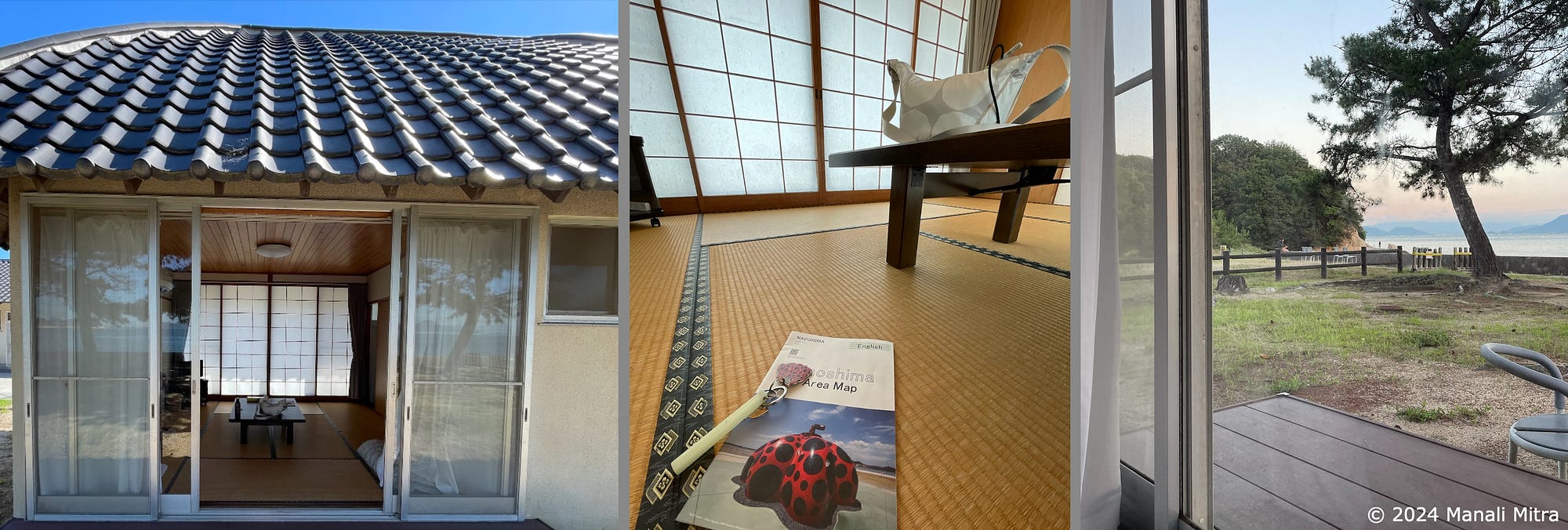
It was past six, and after a fulfilling day of art pilgrimage, I checked into my accommodation, pleasantly surprised by its charm. The resort had already arranged my dinner. After a refreshing bath and dinner, I made my way back to the Benesse Museum to immerse myself in “The Secret of the Sky.”
The real triumph of this island is the seamless synthesis of art, architecture, and nature. The artworks don’t just stand alone; they’re part of a beautifully integrated whole. The peaceful aura of Naoshima Island enhances the connection between viewers and the artwork, but it’s Tadao Ando’s prowess that truly makes it work.
I was excited for the next day, ready to dive into more art, architecture, and nature.
© 2024 Manali Mitra. All Rights Reserved.

 The Unsent Postcard | Travel Stories by Manali Mitra
Leave a comment